
Custom Insoles vs Prefab Insoles – What’s Right for Your Feet?
When foot pain, joint misalignment, or walking discomfort begins to interfere with daily life, the right insole can become more than just support—it becomes treatment. The question is: should you choose custom insoles, designed through advanced podiatric diagnostics, or rely on prefab insoles, commonly available over the counter?
At Freedom Clinics in London, our podiatry team helps you understand the difference between these two orthotic solutions. We specialise in diagnosing foot and gait-related conditions using gait analysis, biomechanics assessments, and 3D pressure mapping. This allows us to determine whether your symptoms require prescription-grade custom orthotics or whether a well-matched prefabricated insole might offer adequate support.
Medically reviewed by: Dr Priya Anand DPM. Last update: 18th May 2026
Book your appointment
Why the Right Insole Matters
According to a Cochrane systematic review by Hawke et al. (2008) from the Cochrane Library, custom-made foot orthoses—prescribed based on detailed podiatric evaluation—demonstrated similar effectiveness to prefabricated insoles in alleviating foot pain, including plantar fasciitis, over a two‑ to three‑month period.
Prefab insoles, in contrast, are mass-produced and provide generic arch and heel support. While suitable for short-term comfort or light activity, they often fail to address the structural or neuromuscular root causes of pain—especially in cases requiring targeted realignment or pressure redistribution.
Our Clinical Differentiator
Using technologies like clinical gait analysis, digital foot scanning, and movement pattern screening, our practitioners map out your foot function in motion. If your pain stems from imbalances, custom orthotics will be recommended to prevent further deterioration. For minor discomfort, we might suggest a high-quality over-the-counter orthotic with modifications.
Understanding Orthotics and Insole Types
Making the right choice between custom insoles and prefabricated orthotics starts with understanding what orthotics are, how they function, and when each type is appropriate. In clinical podiatry, orthotics are medical-grade inserts used to align the foot, redistribute pressure, and correct imbalances in gait and posture. They play a pivotal role in treating foot pain, improving mobility, and preventing injury.
What Are Orthotics?
Orthotics are specialised shoe inserts that improve how the foot functions during walking, standing, or running. Prescribed by a podiatrist, orthotics help:
- Correct biomechanical abnormalities such as overpronation
- Reduce pressure on joints and soft tissues
- Treat conditions like plantar fasciitis, flat feet, bunions, and heel pain
- Improve gait efficiency and lower limb alignment
There are two major types of orthotics:
- Custom orthotics – individually designed based on a clinical evaluation
- Prefabricated orthotics – generic, over-the-counter solutions for general support

What Are Custom Insoles (Custom Orthotics)?
Custom insoles—also known as prescription orthotics—are created specifically for the patient’s unique foot structure and movement patterns. At Freedom Clinics, this personalised process includes:
- Gait analysis to identify alignment and movement issues
- 3D foot scanning to capture anatomical dimensions
- Foot pressure mapping to locate imbalances and pain zones
Custom orthotics are most effective for treating:
- Overpronation
- Flat feet and high arches
- Morton’s neuroma
- Metatarsalgia
- Diabetic foot complications
- Lower limb postural imbalance
These insoles are precision-made to match your foot profile, activity level, and footwear. They offer long-term relief, stability, and preventive support for chronic foot and joint conditions.
What Are Prefabricated Insoles (Prefab Orthotics)?
Prefabricated insoles, often marketed as over-the-counter orthotics, are mass-produced inserts available in most pharmacies and online. They offer general support benefits such as:
- Basic arch support
- Heel cushioning
- Moderate shock absorption
However, they are not tailored to your foot’s structure or motion pattern, which means:
- They may not correct the root cause of chronic pain
- Misalignment can persist or worsen if used inappropriately
- They provide limited therapeutic value for diagnosed foot conditions
Prefab insoles are appropriate for:
- Short-term relief from mild discomfort
- Non-clinical users seeking general comfort
- Temporary or low-impact support needs
The Role of Podiatric Diagnostics in Insole Prescription
Before recommending custom insoles or prefabricated orthotics, a qualified podiatrist must assess the root causes of your foot pain or biomechanical dysfunction. At Freedom Clinics, our diagnostic process uses advanced tools—gait analysis, 3D foot scanning, and foot pressure mapping—to create a clinically accurate orthotic prescription tailored to your movement, structure, and condition.
Gait Analysis: Uncovering Movement Dysfunction
Gait analysis evaluates how your feet move while walking or running. Through motion tracking and video assessment, our podiatrists identify:
- Overpronation or supination
- Asymmetries in stride length and step timing
- Abnormal pressure distribution across the heel, arch, and forefoot
- Rotational stress on the knees and hips
These patterns help determine whether a custom orthotic is needed to restore balance and correct joint alignment.
3D Foot Scanning: Mapping Structural Specifics
We use high-resolution 3D foot scanners to model each foot’s:
- Arch contour
- Heel angle and rearfoot alignment
- Toe orientation and metatarsal position
This detailed scan allows us to design custom insoles that conform precisely to your anatomy, ensuring optimal fit, support, and long-term pain prevention.
Foot Pressure Mapping: Identifying Load Imbalances
Pressure-mapping systems detect force concentration zones as you stand and move. This reveals:
- High-pressure areas prone to pain or tissue breakdown
- Load shifts contributing to plantar fasciitis, bunions, or Morton’s neuroma
- Disparities between left and right limb biomechanics
By understanding how your body weight is distributed, we can customise the density and contour of your orthotic insert to relieve stress and stabilise gait.
Biomechanics Assessment: Aligning the Whole Body
Beyond your feet, our biomechanics evaluation assesses:
- Knee tracking, hip alignment, and pelvic balance
- Functional leg length discrepancies
- Core engagement and postural compensation
This full-body insight ensures your orthotic solution supports more than just your arch—it addresses systemic dysfunctions that affect your mobility and joint health.
Why Diagnostics Matter Before Choosing Insoles
Research published in BMC Musculoskeletal Disorders in 2018 reported that custom foot orthoses significantly reduced first‑step pain and decreased plantar fascia thickness over 12 weeks compared to sham insoles in individuals with plantar fasciopathy—highlighting the importance of diagnostic-based, individualised prescriptions. At Freedom Clinics:
- We prescribe orthotics based on measurable dysfunction, not symptoms alone
- We determine the ideal insole material, contour, and rigidity from clinical evidence
- We prevent overtreatment and under-treatment through diagnostic precision
Key Differences Between Custom and Prefab Insoles
While both custom insoles and prefabricated orthotics are designed to support the feet and improve comfort, they differ significantly in how they are prescribed, manufactured, and used in both clinical and non-clinical settings. Understanding these differences is critical for anyone experiencing chronic foot conditions or seeking long-term biomechanical correction.
1. Fit and Customisation
Custom Insoles
- Precisely crafted using 3D foot scans, gait analysis, and pressure mapping.
- Designed to match your arch height, foot contour, and movement pattern.
- Ensure balanced load distribution, joint alignment, and pain prevention.
Prefab Insoles
- Mass-produced in standard shapes and sizes.
- Offer general arch and heel support, not tailored to individual foot anatomy.
- May not adequately support unique foot types or address underlying dysfunction.
2. Diagnostic Pathway
Custom Orthotics
- Require evaluation by a podiatrist using tools like biomechanics assessment and gait testing.
- Target specific dysfunctions like overpronation, supination, and joint misalignment.
- Used to treat both symptoms and root causes.
Prefabricated Insoles
- Selected based on user judgment or retailer guidance.
- Do not consider clinical data or individual gait mechanics.
- Can exacerbate issues if not correctly fitted or if used for complex conditions.
3. Clinical Use and Medical Conditions
Custom Insoles Support:
- Plantar fasciitis
- Flat feet / Pes planus
- Morton’s neuroma
- Diabetic neuropathy
- Postural instability
- Arthritic foot and ankle pain
Prefab Insoles Are Suited For:
- Temporary arch fatigue
- Mild heel pain
- General lifestyle comfort without medical conditions
4. Longevity and Value
Custom Orthotics
- Engineered for durability: lifespan of 1 to 3 years.
- Often reimbursed under private health insurance plans.
- Offer long-term therapeutic value by preventing further injury.
Prefab Orthotics
- Typically wear out in 3 to 6 months.
- Lower initial cost, but higher long-term replacement frequency.
- Not usually covered by medical insurance or care plans.
5. Activity-Specific Use Cases
Custom Insoles
- Adapted for running, workplace standing, or sports rehabilitation.
- Configured to specific footwear types including athletic, formal, or orthopaedic shoes.
- Frequently prescribed in occupational medicine and sports podiatry.
Prefab Insoles
- Useful for light walking and short-term everyday use.
- Often unsuitable for high-impact activities or professional athletic performance.
- Less effective for users with high BMI or musculoskeletal instability.
Comparison Table: Custom Insoles vs Prefab Insoles
To help you choose the right insole for your condition, we’ve created a comprehensive comparison of custom insoles—also referred to as prescription orthotics—and prefabricated insoles, commonly available over the counter. This table highlights how these insole types differ in design, clinical relevance, durability, and therapeutic effectiveness.
| Feature | Custom Insoles (Prescription Orthotics) | Prefab Insoles (Over-the-Counter Inserts) |
|---|---|---|
| Diagnostic Requirement | Prescribed after clinical testing: gait analysis, foot pressure mapping | No diagnostic input; self-selected based on packaging or size |
| Prescribing Professional | Evaluated and issued by a qualified podiatrist | No healthcare involvement; user-driven purchase |
| Design Method | Created from 3D scans and biomechanical assessments | Generic mold designed to fit most shoes and foot shapes |
| Medical Use Case | Treats chronic conditions: plantar fasciitis, neuroma, flat feet, diabetic foot | Designed for general support and occasional fatigue relief |
| Precision Fit | Matches arch height, foot width, pressure zones, and heel contour | One-size-fits-most; limited support customisation |
| Durability & Longevity | Built to last 1–3 years, depending on materials and activity level | Lasts 3–6 months, deteriorates faster under high usage |
| Support Specificity | Targets dysfunctional foot mechanics; offers segmental pressure redistribution | Provides broad, non-specific cushioning and support |
| Footwear Compatibility | Configured for use in athletic, occupational, formal, and orthopaedic shoes | May require trimming or adjustment; incompatible with some footwear |
| Insurance Coverage | Often covered under private medical insurance with podiatry endorsement | Typically not reimbursable |
| Best For | Individuals with diagnosed biomechanical dysfunctions or complex gait issues | Casual users with mild, undiagnosed discomfort |
Benefits of Custom Insoles
Custom insoles, also referred to as prescription orthotics, provide clinically tailored support that goes far beyond general comfort. Designed from advanced diagnostic data including gait analysis, 3D foot scanning, and biomechanical assessment, these insoles offer measurable improvements in posture, pain relief, injury prevention, and overall functional alignment.
Prescribed by a podiatrist, custom insoles are especially effective for patients with diagnosed conditions such as plantar fasciitis, flat feet, and neuromuscular dysfunction—or for individuals seeking a preventive orthotic strategy tailored to their gait and activity.
1. Biomechanical Correction and Postural Realignment
Custom orthotics are engineered to:
- Correct foot and ankle misalignments
- Reduce excessive overpronation or supination
- Stabilise the rearfoot, support the arch, and align the forefoot
This optimises your gait mechanics, improves balance, and supports the entire kinetic chain—from the foot to the lower back.
2. Pain Reduction for Specific Foot Conditions
Custom insoles are highly effective in alleviating pain from:
- Plantar fasciitis
- Morton’s neuroma
- Metatarsalgia
- Heel spurs
- Posterior tibial dysfunction
Each insole is calibrated using pressure mapping and 3D scan data to distribute force evenly and reduce mechanical irritation at key stress points.
3. Prevention of Overuse Injuries
By normalising gait and correcting load distribution, custom orthotics:
- Decrease risk of Achilles tendonitis, shin splints, and knee maltracking
- Support healthy movement patterns in runners, athletes, and individuals with repetitive load cycles
- Improve resilience in patients recovering from surgery or injury
4. Cost Efficiency Over Time
Although custom insoles involve an initial investment, their lifespan and therapeutic value lead to:
- Reduced frequency of replacements (lasts 1–3 years)
- Fewer clinic visits for recurring pain
- Eligibility for insurance reimbursement under podiatry coverage in many health plans
5. Integration with Lifestyle and Footwear
Custom insoles are precision-fit for:
- Sports shoes (running, hiking, training)
- Occupational footwear (safety boots, standing work shoes)
- Formal and orthopaedic shoes
They offer:
- Improved foot-to-ground contact
- Enhanced shock absorption
- Increased comfort for extended wear across various surfaces

When Are Prefab Insoles a Good Choice?
Prefabricated insoles—also referred to as over-the-counter orthotics—are standardised, mass-produced foot supports that can offer meaningful relief for specific use cases. While not clinically tailored like custom insoles, they are an effective option for individuals without underlying biomechanical dysfunction who seek comfort, temporary support, or budget-friendly orthotic solutions.
1. Mild, Non-Pathological Foot Discomfort
Prefab insoles are ideal for relieving:
- Arch fatigue from prolonged standing
- Heel discomfort after wearing unsupportive footwear
- General foot tiredness without structural abnormalities
These inserts provide baseline arch support, heel cushioning, and light shock absorption, helping to reduce day-to-day foot strain.
2. Cost-Conscious or First-Time Insole Users
For individuals not yet ready for clinical intervention:
- Prefab insoles offer an accessible, low-cost solution
- Widely available in pharmacies and athletic retail outlets
- Categorised by generic foot profiles (e.g., low arch, neutral arch)
They serve as a useful trial product before pursuing custom orthotic evaluation.

3. Situational Relief During Travel or Footwear Transitions
When you’re:
- Switching to a new shoe type
- Traveling and need portable support
- Waiting for custom insoles to be manufactured or adjusted
Prefabricated insoles act as a versatile backup, adaptable across different shoe models.
4. Light Activity and Low-Impact Foot Support
These insoles are appropriate for:
- Walking short distances
- General office or household use
- Temporary relief from hard flooring or flat footwear
They are not designed for running, athletics, or conditions requiring gait correction but serve well for casual or infrequent use.
5. Podiatrist-Approved Use Without Structural Issues
In some clinical cases, a podiatrist may recommend prefabricated insoles when:
- No biomechanical abnormalities are present
- Discomfort is linked to footwear or workload
- The user is seeking interim relief while awaiting full assessment
This preserves their role as part of a graduated foot care approach, bridging the gap between casual use and therapeutic prescription.
Conditions Best Treated with Custom Insoles
Custom insoles—also referred to as prescription orthotics—are designed to correct biomechanical imbalances and manage medically diagnosed foot and lower limb conditions. Prescribed following podiatric diagnostics such as gait analysis, foot pressure mapping, and 3D scanning, these medical-grade insoles offer targeted relief and functional realignment for patients experiencing chronic pain, instability, or neuropathic symptoms.
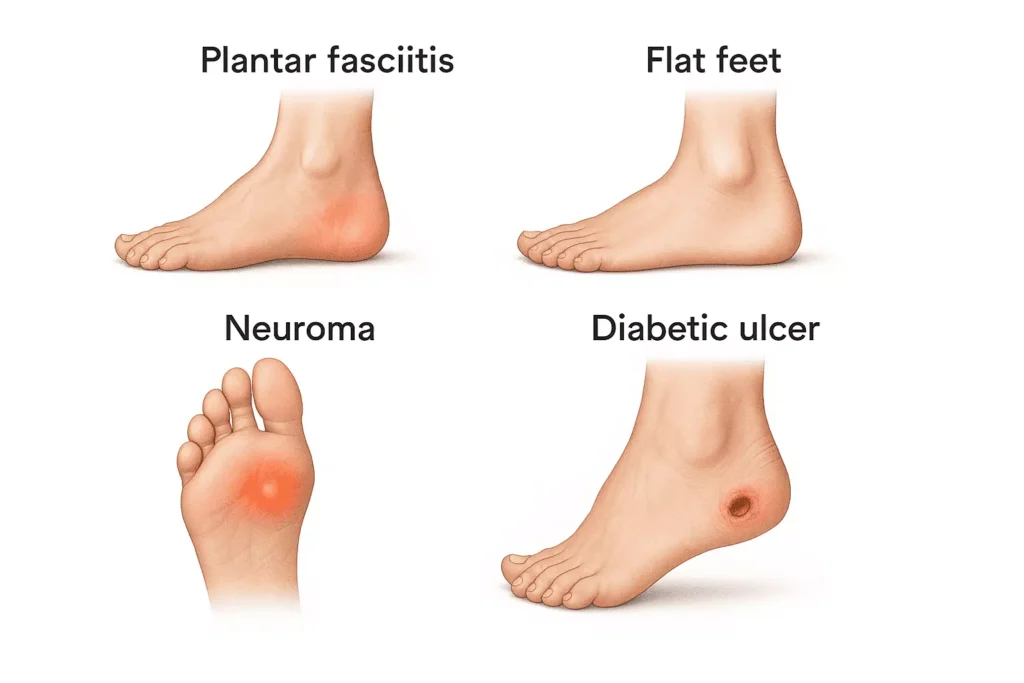
1. Plantar Fasciitis
This common cause of heel pain is linked to overloading of the plantar fascia due to poor arch support or misaligned gait. According to a 2020 randomised controlled trial at the Faculty of Podiatry, University of Seville, wearing custom-made foot orthoses significantly reduced pain and improved foot function in patients with plantar fasciitis compared to placebo insoles over six months. Custom insoles:
- Reduce strain on the fascia
- Elevate the arch to improve tension distribution
- Cushion the heel to minimise impact
2. Flat Feet (Pes Planus)
Characterised by low or collapsed arches, flat feet often lead to overpronation, fatigue, and pain in the ankles or knees. Custom orthotics:
- Rebuild arch structure
- Control foot rollover
- Prevent long-term joint misalignment
3. Morton’s Neuroma
A condition caused by nerve compression in the forefoot, leading to numbness or burning between the toes. Custom insoles:
- Offload pressure from the metatarsal heads
- Add spacing or cushioning to reduce impingement
- Improve shoe fit and reduce irritation
4. Diabetic Foot Complications
Patients with diabetic neuropathy or high ulceration risk benefit from custom orthotics that:
- Equalise plantar pressure
- Reduce shear and friction
- Prevent skin breakdown and callus formation
These insoles are essential in diabetic foot care protocols.
5. Posterior Tibial Tendon Dysfunction (PTTD)
This progressive tendon disorder weakens arch support and alters foot mechanics. Custom orthotics:
- Stabilise the medial arch
- Decrease strain on the posterior tibial tendon
- Slow or prevent structural collapse
6. Metatarsalgia and Forefoot Pressure Syndromes
Pain in the ball of the foot from impact or overuse is alleviated by insoles that:
- Use metatarsal pads to offload pressure
- Balance weight across the forefoot
- Enhance shock absorption in the push-off phase of gait
7. Leg Length Discrepancy and Gait Asymmetry
Custom insoles can be adapted with heel lifts or midsole elevations to:
- Correct uneven limb length
- Balance pelvic alignment
- Reduce compensation in the spine and hips
FAQs About Custom and Prefab Insoles
Whether you’re exploring custom insoles for a diagnosed foot condition or considering prefabricated orthotics for everyday comfort, these answers address the most common questions asked by patients at Freedom Clinics.
What are custom insoles and who are they for?
Custom insoles—also called prescription orthotics—are medical devices tailored to your foot’s structure and biomechanics. Prescribed by a podiatrist after a diagnostic evaluation (e.g. gait analysis, 3D foot scanning), they are ideal for treating:
- Plantar fasciitis
- Flat feet
- Posterior tibial tendon dysfunction
- Diabetic foot complications
When are prefab insoles a suitable alternative?
Prefabricated insoles work well for:
- Mild arch or heel discomfort
- Foot fatigue from prolonged standing
- Temporary relief during footwear transitions
However, they are not designed for clinical correction of biomechanical dysfunctions.
How do custom and prefab insoles differ?
| Feature | Custom Insoles | Prefab Insoles |
|---|---|---|
| Diagnostic Requirement | Yes – podiatrist & gait analysis | No – self-selected |
| Fit & Precision | Tailored to foot structure | Standardised, generic fit |
| Clinical Use | Prescribed for specific foot conditions | Intended for general support |
| Durability | 1–3 years | 3–6 months |
| Insurance Coverage | Often eligible with health plans | Rarely reimbursed |
Are custom orthotics covered by private health insurance?
Yes, in many cases. If prescribed by a registered podiatrist, custom insoles may be reimbursed under private medical insurance policies. Check your provider’s criteria.
How long do insoles last before needing replacement?
- Custom insoles: 12–36 months (material dependent)
- Prefab insoles: 3–6 months
Signs it’s time to replace include visible wear, loss of support, or return of symptoms.
Can I wear my custom insoles in all shoes?
Typically, yes. Custom orthotics can be designed to fit:
- Trainers and running shoes
- Occupational footwear
- Dress shoes and diabetic footwear
Your podiatrist may recommend different orthotics for different footwear needs.
Do I need a podiatrist to get custom insoles?
Yes. Only a qualified podiatrist can prescribe custom orthotics after conducting:
- Gait analysis
- Foot pressure mapping
- 3D scanning or manual foot evaluation
This ensures the insole is therapeutic, not just supportive.
How to Get Custom Insoles at Freedom Clinics
At Freedom Clinics in Canary Wharf, London, we specialise in the diagnosis and treatment of foot and lower limb conditions using medically prescribed custom insoles, also known as prescription orthotics. Our process integrates advanced podiatric diagnostics—including gait analysis, 3D foot scanning, and foot pressure mapping—to design orthotics that relieve pain, restore alignment, and optimise mobility.
Step 1: Book a Consultation with a Podiatrist
Your journey begins with a clinical foot health consultation at our Canary Wharf podiatry clinic. During this appointment, our registered podiatrist will assess:
- Symptoms such as heel pain, flat feet, overpronation
- Gait irregularities or posture issues
- Lifestyle needs and footwear usage
Step 2: Diagnostic Testing for Precision Prescription
Your assessment includes:
- Gait analysis to examine walking and running mechanics
- 3D foot scanning to measure arch profile and foot structure
- Pressure mapping to detect high-load zones and balance issues
These tools ensure your custom insoles are engineered for precise biomechanical correction and personalised fit.

Step 3: Custom Orthotic Fabrication and Fitting
Following diagnostics, your prescription orthotics are:
- Designed for your unique foot and condition
- Tailored to your footwear—sports shoes, work boots, or formal wear
- Fitted and adjusted for immediate comfort and alignment
Your podiatrist will guide you through the break-in process and provide usage instructions.
Step 4: Review and Long-Term Support
To ensure long-term success, we offer:
- Follow-up appointments for orthotic optimisation
- Adjustments based on symptom changes or footwear updates
- Ongoing care planning in coordination with physiotherapists or GPs if needed
Freedom Clinics – Custom Insoles in Canary Wharf, London
Address:
Canada Place Shopping Mall
34 North Colonnade
Canary Wharf, London E14 5HX
Contact:
0203 197 9100
canarywharf@freedomclinics.com
Opening Hours:
Monday–Friday: 7am–8pm
Saturday–Sunday: 10am–4pm
Our Podiatrists & Chiropodists


References
- Hawke, F., Burns, J., Radford, J. A., & du Toit, V. (2008). Custom‑made foot orthoses for the treatment of foot pain. Cochrane Database of Systematic Reviews, (3), CD006801. https://doi.org/10.1002/14651858.CD006801.pub2
- Landorf, K. B., Fogg, A. J., McCabe, C., Christine, J., Cotchett, M. P., & Menz, H. B. (2018). Custom foot orthoses improve first‑step pain in individuals with plantar fasciopathy: A randomized controlled trial. BMC Musculoskeletal Disorders, 19, 97. https://doi.org/10.1186/s12891-018-2131-6
- Coheña-Jiménez, M., Pabón-Carrasco, M., & Pérez Belloso, A. J. (2021). Comparison between customised foot orthoses and insole combined with the use of extracorporeal shock wave therapy in plantar fasciitis, medium-term follow-up results: A randomised controlled trial. Clinical rehabilitation, 35(5), 740–749. https://doi.org/10.1177/0269215520976619

