
Upper Crossed Syndrome & Postural Dysfunction
Upper Crossed Syndrome (UCS) is a well‑defined postural dysfunction and biomechanical imbalance that affects the neck, shoulders, and upper back. It is most commonly recognised by forward head posture, rounded shoulders, and increased tension through the upper spine. Upper Crossed Syndrome develops gradually as a result of sustained postures, repetitive desk-based work, and prolonged screen use.
At Freedom Clinics in Canary Wharf, chiropractors frequently identify Upper Crossed Syndrome in people who spend long hours seated at a desk or working on laptops. Many patients seek care for neck pain, shoulder tightness, or posture-related headaches, without realising these symptoms are linked by an underlying postural pattern rather than a single injury.
Book your appointmentMedically reviewed by Tanesa Mohan (MChiro LRCC). Last update: 06 February 2026.

Upper Crossed Syndrome is driven by a predictable pattern of muscle imbalance. Muscles such as the upper trapezius, levator scapulae, and pectoralis minor often become tight, shortened, and overactive. At the same time, key postural stabilisers — including the deep neck flexors, lower trapezius, and serratus anterior — become weak or inhibited. This imbalance alters normal alignment of the cervical spine, increases strain through the upper thoracic spine, and reduces the body’s ability to maintain efficient posture.
As this postural dysfunction progresses, everyday activities such as computer work, driving, or sitting upright can place excessive stress on the neck and shoulders. Without proper assessment and correction, Upper Crossed Syndrome may contribute to persistent pain, reduced movement quality, and recurring flare‑ups.
The good news is that Upper Crossed Syndrome responds well to early posture assessment, targeted chiropractic treatment, and structured rehabilitative exercise. At Freedom Clinics, care is focused on correcting the underlying muscular imbalance, restoring postural control, and helping patients in Canary Wharf reduce pain while preventing recurrence.
Understand Upper Crossed Syndrome
What causes Upper Crossed Syndrome?
Upper Crossed Syndrome is caused by long-term postural overload, where the body adapts to inefficient positions — particularly forward head posture, rounded shoulders, and collapsed thoracic alignment. These patterns commonly emerge from sitting at a desk for hours, using a laptop without proper support, or leaning forward while looking at mobile devices.
When this becomes habitual, the upper trapezius, levator scapulae, and pectoralis minor become tight and overused, while the deep neck flexors, serratus anterior, and lower trapezius become underactive or neurologically inhibited. This mismatch creates a crossed pattern of imbalance, distorting the body’s natural movement and loading mechanics.
Left untreated, this imbalance reinforces itself, leading to chronic neck stiffness, scapular instability, and reduced postural endurance. The longer these patterns persist, the harder it becomes to maintain an upright posture without discomfort or fatigue — especially during activities like typing, reading, or commuting.
How Upper Crossed Syndrome Presents Visually
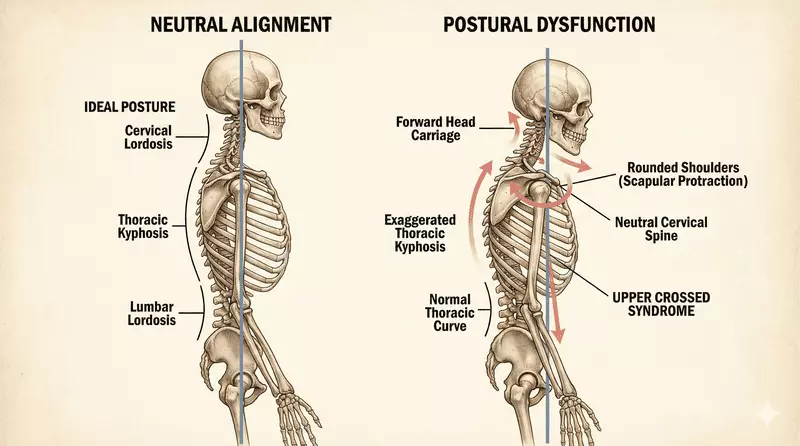
Clinically, chiropractors identify Upper Crossed Syndrome through distinct postural markers, such as:
- Forward head posture – where the chin juts forward, increasing cervical strain
- Rounded shoulders – with scapulae abducted and protracted
- Exaggerated thoracic kyphosis – increasing joint compression and fatigue
- Scapular elevation or winging – impairing shoulder mechanics and stability
These visual features are often obvious during a posture screen or when observing someone seated from the side. They reflect deeper musculoskeletal dysfunctions that can lead to long-term structural stress and reduced function.
Who is Most at Risk?
At Freedom Clinics Canary Wharf, we frequently see Upper Crossed Syndrome in:
- Desk-based professionals and digital workers
- Students and exam revision learners
- Remote workers with poor home office ergonomics
- Drivers, commuters, and anyone seated for extended periods
- Athletes in chest-dominant training (e.g., bodybuilders, swimmers)
Many of these patients report neck tension, shoulder fatigue, or recurrent headaches that worsen with screen use or prolonged sitting. Even those who stretch regularly or exercise may still struggle with underlying postural dysfunction unless muscle balance is specifically addressed.
By identifying the early signs of Upper Crossed Syndrome, our chiropractic team can intervene before these patterns lead to deeper spinal dysfunction, referred pain, or movement compensations. Early action prevents chronic adaptation and supports long-term posture correction.
Anatomy of the Muscular Imbalance
Upper Crossed Syndrome (UCS) involves a well-documented pattern of muscle imbalance that affects posture, movement, and joint function in the upper body. It features two key dysfunctions: the overactivity and tightness of certain anterior and posterior chain muscles, and the underactivity or weakness of deep postural stabilisers. Together, these imbalances impair scapular control, cervical spine alignment, and neuromuscular efficiency.
Muscles That Become Tight and Overactive
In response to prolonged seated posture, certain muscles become shortened, hypertonic, and functionally dominant, including:
- Upper trapezius – contributes to shoulder elevation and cervical restriction
- Levator scapulae – elevates the scapula and pulls the neck into ipsilateral rotation
- Pectoralis major and minor – draw the shoulders forward, compressing the anterior shoulder capsule
- Sternocleidomastoid (SCM) – compensates for weak deep neck flexors, often associated with head tilting
- Suboccipitals – tighten in response to forward head posture, increasing compressive forces on the craniovertebral junction
These muscles tend to carry excessive load due to poor activation of their stabilising counterparts. This leads to increased passive tissue strain, postural fatigue, and altered joint mechanics at the neck, shoulders, and thoracic spine.

Muscles That Become Weak and Underactive
Conversely, a group of essential stabilisers becomes inhibited, reducing postural support and motor coordination:
- Deep cervical flexors – provide cervical spine stability and chin tuck control
- Lower trapezius – stabilises the scapula in depression and assists thoracic extension
- Serratus anterior – prevents scapular winging and facilitates upward rotation during arm elevation
- Rhomboids – support retraction of the scapula and thoracic posture integrity
This underactivity often stems from reciprocal inhibition, where overactive muscles suppress their antagonists. Over time, poor neuromuscular patterning leads to reduced endurance, diminished proprioception, and impaired movement quality in both static posture and dynamic tasks.
Postural and Functional Impacts
These muscular imbalances manifest in several postural distortions and movement limitations:
- Forward head posture, increasing cervical disc load and muscular strain
- Rounded shoulders, reducing scapular kinematics and shoulder mobility
- Exaggerated thoracic kyphosis, altering spinal alignment and breathing patterns
- Scapular winging, linked to shoulder instability and dysfunction during lifting or reaching
A biomechanical study conducted by the Division of Biokinesiology and Physical Therapy at the University of Southern California demonstrated that forward head posture significantly increases cervical extensor muscle load and thoracic spinal strain, impairing postural efficiency during sustained seated tasks.
At Freedom Clinics Canary Wharf, we assess these patterns through muscle testing, posture screens, and movement analysis, enabling precise interventions that correct both the mechanical and neuromuscular aspects of Upper Crossed Syndrome.
Recognising the Symptoms and Functional Impacts
Upper Crossed Syndrome (UCS) leads to a cascade of physical symptoms and functional limitations driven by persistent muscle imbalance and postural dysfunction.
According to foundational work from the Prague School of Rehabilitation, Upper Crossed Syndrome was described as “a pattern of muscle imbalance which is situated over head and shoulder region which is mainly due to bad posture.” It’s a predictable pattern of muscle imbalance involving tonic muscle tightness and phasic muscle inhibition, resulting in altered posture, reduced movement efficiency, and cumulative musculoskeletal symptoms. These symptoms often progress gradually and are commonly misattributed to tension, poor fitness, or general fatigue — delaying appropriate intervention.
How Upper Crossed Syndrome Affects the Body
The most prominent symptoms are tied directly to overactive and underactive muscle groups, altered spinal alignment, and reduced dynamic control:
- Neck pain and stiffness due to chronic overactivation of the upper trapezius and levator scapulae
- Tension headaches, typically originating from tight suboccipitals in response to forward head posture
- Shoulder discomfort related to scapular elevation and poor stabilisation
- Upper back and mid-thoracic tightness, linked to rhomboid and lower trapezius inhibition
- Restricted breathing from anterior chest tightness and thoracic rigidity
These symptoms are exacerbated by long hours of desk work, driving, or screen use, and while stretching may provide temporary relief, symptoms often return without addressing the underlying postural and muscular dysfunctions.
Symptoms That Suggest Postural Dysfunction
Key indicators of Upper Crossed Syndrome include:
- A visibly forward head posture or rounded shoulders
- One shoulder appearing higher or more rotated than the other
- Reduced range of motion in the neck or shoulders
- Scapular winging or instability during arm elevation
- Fatigue when sitting upright, even with ergonomic support
- Soreness or discomfort after basic tasks like typing, carrying a bag, or reaching overhead
Such signs often reflect breakdowns in scapulothoracic control, cervical stabilisation, and thoracic extension mechanics — hallmarks of UCS-related dysfunction.
Functional Red Flags for Clinical Assessment
You should consider professional assessment at Freedom Clinics Canary Wharf if you experience:
- Persistent neck, shoulder, or upper back pain not relieved by rest or movement
- Frequent headaches that follow extended screen time or poor seated posture
- Difficulty maintaining upright posture without muscular fatigue
- A history of poor response to general exercise or stretching for posture correction
Our chiropractors use detailed postural screening, orthopaedic movement analysis, and muscle activation testing to determine whether Upper Crossed Syndrome is present — and to develop a structured plan that targets the root causes of these patterns.
How We Assess for UCS at Freedom Clinics
At Freedom Clinics Canary Wharf, we use a structured, evidence-informed approach to diagnose Upper Crossed Syndrome (UCS). Our assessment process includes visual postural analysis, muscle function testing, and functional movement screening to identify the underlying muscle imbalances, joint restrictions, and neuromuscular patterns associated with UCS.
Visually Detecting Postural Imbalance
Assessment begins with a comprehensive posture screen, where we evaluate spinal alignment and muscular symmetry from multiple planes. Key features of UCS we look for include:
- Forward head posture, signalling underactive deep cervical flexors and cervical extensor dominance
- Rounded shoulders, often caused by shortened pectoralis minor and weak scapular retractors
- Thoracic hyperkyphosis, contributing to breathing inefficiency and spinal stiffness
- Uneven shoulder height, suggesting unilateral overuse of the upper trapezius or levator scapulae
We use tools like plumb line assessments, digital posture grids, and photographic benchmarks to identify and measure these deviations accurately.
Testing Muscle Activation and Scapular Control
Once visual posture markers are noted, we test muscle performance and coordination through specific functional screens:
- Deep neck flexor endurance test (e.g., supine chin tuck hold) to assess cervical stability
- Wall angel or wall slide test to evaluate scapular mobility and thoracic extension
- Shoulder flexion or abduction with scapular observation for winging or premature elevation
- Passive and active ROM testing to assess restriction and compensation
- Sit-to-stand and reach tests to observe postural fatigue and movement quality
These tests help identify reciprocal inhibition, underactive stabilisers, and altered scapulothoracic mechanics — all of which are identified during a clinical posture screen.
Linking Postural Dysfunction to Symptom Patterns
The final step is correlating structural and functional findings with your symptoms. This allows us to:
- Attribute neck pain, headaches, or shoulder discomfort to specific muscular or joint imbalances
- Identify compensatory movement patterns contributing to ongoing dysfunction
- Determine if UCS is the primary driver or co-existing condition within a broader postural syndrome
This comprehensive evaluation ensures that your treatment plan directly addresses the root causes of your symptoms, which is essential for managing chronic neck pain and promoting long-term correction.
Chiropractic Treatment for Upper Crossed Syndrome
At Freedom Clinics Canary Wharf, our chiropractic treatment for Upper Crossed Syndrome (UCS) focuses on correcting the root muscular imbalances, joint restrictions, and postural dysfunctions that contribute to pain and functional limitations. Treatment combines manual therapy, spinal adjustments, and rehabilitative exercise to restore alignment, mobility, and neuromuscular control.
Reducing Muscular Tension with Manual Therapy
Manual therapy targets overactive muscles that perpetuate UCS, including the upper trapezius, levator scapulae, and pectoralis minor. Techniques applied include:
- Myofascial release to improve tissue mobility and reduce fascial restriction
- Trigger point therapy for hypertonic regions causing neck and shoulder discomfort
- Instrument-assisted soft tissue mobilisation (IASTM) for chronic tightness
- Proprioceptive Neuromuscular Facilitation (PNF) stretching to lengthen shortened anterior chains
These approaches relieve postural tension, improve range of motion, and prepare muscles for retraining.
These manual approaches relieve postural tension and improve range of motion, providing a foundation for resolving shoulder pain and stiffness.
Restoring Joint Function Through Chiropractic Adjustment
Chiropractic adjustments address joint restrictions contributing to UCS:
- Cervical adjustments improve spinal mobility and facilitate deep neck flexor activation
- Thoracic manipulations enhance thoracic extension and support scapular mechanics
- Scapulothoracic mobilisation restores normal scapular glide, reducing compensatory overuse of postural muscles
All adjustments are tailored based on your presentation, focusing on safety, precision, and the delivery of professional chiropractic care.
Rebuilding Postural Control with Rehabilitation
Rehabilitation exercises reinforce neuromuscular re-education and strengthen underactive muscles:
- Chin tucks activate the deep cervical flexors for cervical stability
- Wall slides and prone Y/T/W exercises strengthen scapular stabilisers
- Serratus anterior activation supports proper scapular motion
- Motor control exercises retrain posture during functional tasks such as reaching, lifting, and sitting
Research from the University of Minnesota Program in Rehabilitation Science demonstrated that adequate serratus anterior activation is essential for normal scapulothoracic rhythm and the prevention of compensatory shoulder elevation during arm elevation.
This phase ensures that improvements are sustained through better neuromuscular control, which is a vital component in preventing long-term disc injury.
Personalising Care for Long-Term Posture Correction
Every treatment plan is customised based on:
- Severity and chronicity of postural deviations
- Co-existing cervical, thoracic, or shoulder conditions
- Functional goals, including workplace posture, exercise performance, or headache reduction
- Patient response to manual therapy and rehabilitative exercises
By combining hands-on correction with targeted rehabilitation, Freedom Clinics helps patients address Upper Crossed Syndrome comprehensively — restoring alignment, reducing pain, and preventing recurrence.

Postural Correction & Exercise Rehabilitation
Following assessment and initial chiropractic treatment, Upper Crossed Syndrome (UCS) is addressed through a structured program of postural correction and rehabilitative exercises, designed to strengthen underactive muscles, improve alignment, and restore neuromuscular control.
Correcting Muscle Imbalances with Targeted Stretching
Stretching is used to release tight and overactive muscles, including:
- Pectoralis minor and major, reducing shoulder protraction
- Upper trapezius and levator scapulae, relieving cervical and shoulder tension
- Thoracic extension exercises, counteracting kyphotic posture and improving spinal mobility
These interventions restore optimal muscle length-tension relationships, enhance range of motion, and prepare the body for stabilising exercises.

Strengthening Underactive Postural Muscles
Strengthening exercises focus on muscles that support postural endurance and scapular control:
- Deep cervical flexors via chin tuck and nodding exercises
- Lower trapezius and rhomboids with prone Y/T/W exercises
- Serratus anterior activation using wall slides or resistance band work
This phase improves cervical stability, scapular mechanics, and overall postural integrity.
Reinforcing Neuromuscular Control During Daily Movement
Exercises are integrated into functional activities to ensure habitual postural correction:
- Sit-to-stand transitions emphasising thoracic extension and scapular retraction
- Overhead reach drills maintaining scapulothoracic rhythm
- Workstation posture cues for prolonged sitting and desk work
This approach retrains the neuromuscular system, supporting long-term alignment and reducing the recurrence of upper back pain and other UCS symptoms.
Personalised Home Exercise Plans
Every patient receives a tailored exercise program based on:
- Specific muscle imbalances identified in the assessment
- Severity of forward head posture, rounded shoulders, and thoracic kyphosis
- Daily activity and occupational demands
Combined with supervised sessions, home exercise routines reinforce postural correction and ensure sustained improvements.
Ergonomics & Lifestyle Adjustments
Addressing Upper Crossed Syndrome (UCS) requires not only treatment and exercise but also ergonomic and lifestyle modifications that reduce strain on overactive muscles, reinforce postural control, and prevent recurrence.
Optimising Workstation Ergonomics for UCS
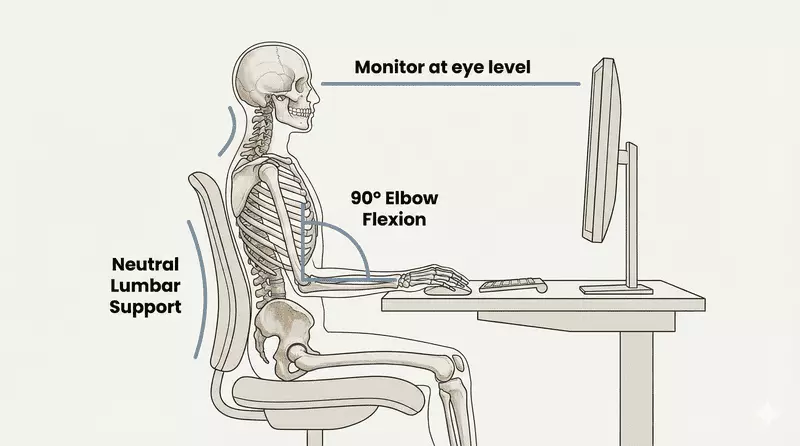
Proper workstation setup helps prevent forward head posture, rounded shoulders, and thoracic kyphosis:
- Monitor placement: Eye level and arm’s length to minimise cervical flexion
- Chair support: Lumbar support and adjustable seat height for optimal spinal alignment
- Keyboard and mouse positioning: Elbows at 90° to reduce shoulder protraction and strain
- Foot positioning: Flat on the floor or on a support to maintain neutral pelvic alignment
These adjustments decrease overuse of upper trapezius and pectoralis muscles, reduce postural fatigue, and promote cervical and thoracic alignment throughout the workday.
Integrating Movement Breaks and Micro-Exercises
Regular movement interrupts static positions that exacerbate UCS:
- Micro-breaks every 30–45 minutes for stretching overactive muscles
- Chin tucks and scapular retractions at the desk to activate deep cervical flexors and lower trapezius
- Thoracic extension exercises to maintain spinal mobility and prevent kyphotic postural collapse
These micro-exercises strengthen underactive stabilisers, reinforce neuromuscular control, and support sustained postural correction.
Adapting Lifestyle Habits to Support Posture
Lifestyle modifications complement ergonomic strategies and exercises:
- Include postural strength and mobility exercises in daily routines
- Maintain awareness of phone usage, driving posture, and load carrying
- Ensure sleep positioning supports cervical and thoracic alignment
These habits integrate UCS correction into everyday life, reducing recurrence and maintaining functional posture.
Personalised Lifestyle Coaching for Sustainable Alignment
At Freedom Clinics Canary Wharf, we provide individualised coaching based on:
- Work environment and desk ergonomics
- Daily activity patterns and occupational demands
- Existing mobility limitations and exercise habits
Combined with clinical treatment and rehabilitation, personalised guidance ensures long-term improvements in Upper Crossed Syndrome, promoting healthy posture and functional movement.
Upper vs Lower Crossed Syndrome: Key Differences
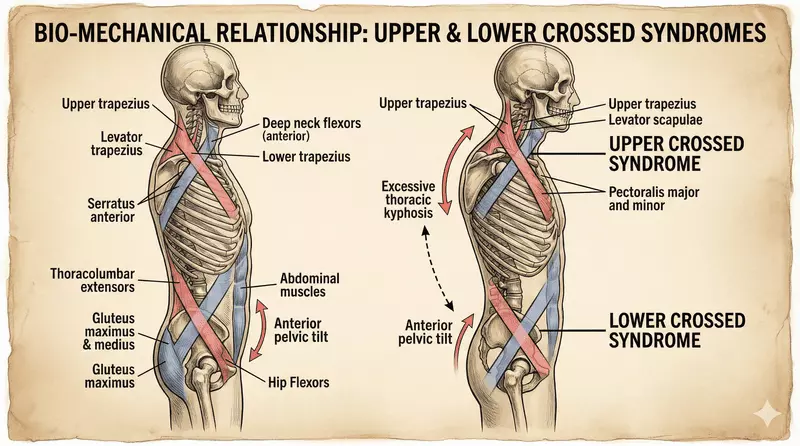
Understanding the differences between Upper Crossed Syndrome (UCS) and Lower Crossed Syndrome (LCS) is essential for designing effective postural correction and rehabilitation strategies. UCS primarily affects the neck, shoulders, and upper back, whereas LCS involves the pelvis, lumbar spine, and hip muscles.
Comparing Affected Muscle Groups
Upper Crossed Syndrome typically presents with:
- Tight/overactive muscles: Upper trapezius, levator scapulae, pectoralis minor/major, sternocleidomastoid
- Weak/inhibited muscles: Deep cervical flexors, lower trapezius, serratus anterior, rhomboids
Lower Crossed Syndrome generally includes:
- Tight/overactive muscles: Hip flexors, erector spinae, adductors
- Weak/inhibited muscles: Gluteus maximus, gluteus medius, abdominals
These distinctions inform targeted stretching and strengthening protocols for each syndrome.
Identifying these distinctions is essential for designing targeted protocols that address both upper body dysfunction and lower back pain.
Distinguishing Postural Features
| Feature | Upper Crossed Syndrome | Lower Crossed Syndrome |
|---|---|---|
| Head/Neck | Forward head posture | Typically neutral |
| Shoulders/Scapula | Rounded shoulders, scapular winging | Usually unaffected |
| Thoracic Spine | Hyperkyphosis | Often normal |
| Lumbar/Pelvis | Typically stable | Increased lumbar lordosis, anterior pelvic tilt |
| Hips | Usually stable | Tight hip flexors, weak glutes |
Understanding Functional Implications
UCS affects upper body mobility, contributing to neck pain, shoulder dysfunction, and cervicogenic headaches.
LCS impacts lower body mechanics, leading to low back pain, reduced hip extension, and altered gait or athletic performance.
Clinical Relevance for Treatment
Identifying whether a patient exhibits UCS, LCS, or a combination informs:
- Manual therapy targeting tight or overactive muscles
- Rehabilitative exercises focused on weak stabilisers
- Postural retraining tailored to affected regions
At Freedom Clinics Canary Wharf, clinicians assess both upper and lower postural syndromes to design comprehensive correction plans that restore balanced muscle function and alignment across the entire kinetic chain.
Why Choose Freedom Clinics Canary Wharf
Selecting the right clinic for Upper Crossed Syndrome (UCS) and related postural conditions is critical for achieving effective, long-term results. Freedom Clinics Canary Wharf combines expert chiropractic care, evidence-based rehabilitation, and personalised postural correction programs to address the root causes of UCS and Lower Crossed Syndrome (LCS).
Delivering Expert Postural Syndrome Care
Our clinicians specialise in assessing and treating Upper and Lower Crossed Syndrome as well as other postural imbalances. Their approach includes:
- Comprehensive posture assessments to identify structural deviations
- Muscle activation and functional movement testing to determine weak and overactive muscles
- Manual therapy and chiropractic adjustments tailored to individual postural patterns
This ensures each patient receives a diagnosis-driven, personalised treatment plan targeting specific muscular and postural dysfunctions.
Integrating Evidence-Based Treatment and Rehabilitation
We implement clinical best practices with a focus on functional outcomes:
- Manual therapy and soft tissue release to alleviate tight muscles such as upper trapezius, levator scapulae, and pectorals
- Rehabilitative exercises to strengthen underactive stabilisers, including deep cervical flexors, lower trapezius, and serratus anterior
- Postural retraining and ergonomic guidance to reinforce alignment in daily activities
This approach ensures pain reduction, improved mobility, and long-term postural correction.
Providing Personalised Postural and Lifestyle Guidance
Patients receive tailored lifestyle strategies to maintain progress:
- Workstation ergonomics and posture coaching for desk-based activities
- Home exercise programs targeting individual muscular imbalances
- Lifestyle adjustments to support spinal health and prevent recurrence
This reinforces Upper Crossed Syndrome correction and promotes sustainable postural health.
Offering Convenient, Comprehensive Local Care
Located in Canary Wharf, Freedom Clinics provides:
- Easy access for professionals and commuters
- Modern facilities equipped for posture assessment, rehabilitation, and chiropractic care
- Integrated services combining clinical treatment, exercise therapy, and lifestyle coaching
Our local presence enables patients to receive consistent, high-quality chiropractic treatment tailored to their occupational and lifestyle requirements.
Our Chiropractors


References
- Szeto, G. P. Y., Straker, L., & O’Sullivan, P. B. (2005). Manual Therapy, 10(4), 270–280. https://doi.org/10.1016/j.math.2005.01.004
- Systematic Review (2025): “Effectiveness of Janda’s Approach for Upper Crossed Syndrome.” Archives of Sports Medicine and Physiotherapy. Read on Med Science Group.
- Ludewig, P. M., & Cook, T. M. (2000). Physical Therapy, 80(3), 276–291. https://academic.oup.com/ptj/article/80/3/276/2857835

