
What Is Scoliosis and How Does It Affect the Spine?
Defining Scoliosis as a Three‑Dimensional Spinal Curvature Condition
Scoliosis is a three‑dimensional spinal condition defined by an abnormal lateral curvature of the spine combined with vertebral rotation. Rather than bending in a single direction, the spine curves and twists, most commonly affecting the thoracic spine, the lumbar spine, or both.
Book your appointmentMedically reviewed by Tanesa Mohan (MChiro LRCC). Last update: 27 January 2026.
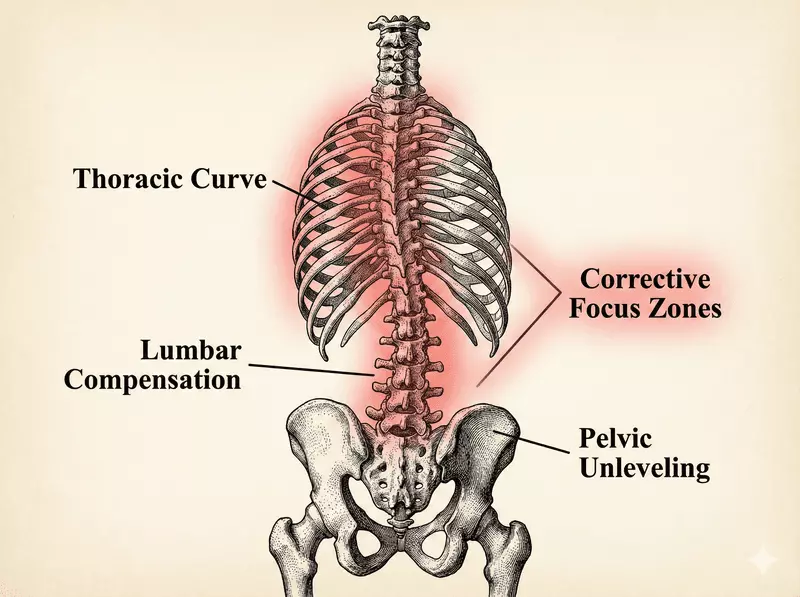
Clinically, scoliosis is diagnosed using the Cobb angle, a standard radiographic measurement taken from spinal X‑rays. A Cobb angle of 10 degrees or more confirms the presence of scoliosis and helps classify its severity.
Key clinical characteristics of scoliosis include:
- Lateral spinal curvature visible from the front or back
- Rotational changes in the vertebrae
- Altered spinal alignment and posture
- Uneven load distribution across the spine
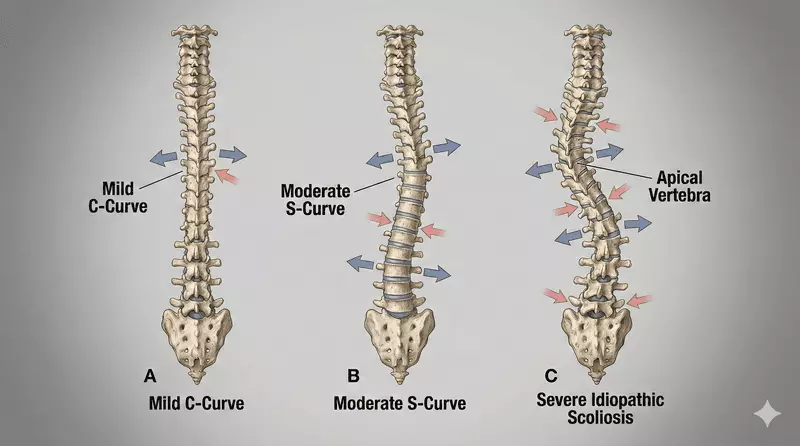
Scoliosis may be classified as:
- Idiopathic scoliosis – the most common form, often developing during adolescence
- Degenerative scoliosis – occurring in adults due to disc degeneration and spinal wear
- Functional scoliosis – caused by postural imbalance, muscle asymmetry, or leg‑length differences
Understanding scoliosis as a structural and biomechanical condition is essential for appropriate management and realistic treatment expectations.
Early Signs, Postural Symptoms, and Risk Factors of Scoliosis
Scoliosis often develops gradually and may not cause immediate pain, particularly in its early stages. However, as spinal curvature and postural compensation increase, visible and functional symptoms typically emerge.
Common signs and symptoms of scoliosis include:
- One shoulder or hip sitting higher than the other
- Visible spinal curve or rib prominence when bending forward
- Postural asymmetry, including uneven waistlines
- Muscle imbalance and tightness, usually more pronounced on one side
- Back pain, stiffness, or fatigue—especially with prolonged sitting or standing

In adults, degenerative scoliosis may also contribute to:
- Reduced spinal mobility
- Nerve irritation, leading to leg discomfort or altered sensation
- Progressive postural collapse over time
Risk factors associated with scoliosis:
- Family history of spinal curvature
- Adolescent growth spurts, particularly during puberty
- Long‑term poor posture or sedentary work habits
- Age‑related disc degeneration and spinal arthritis
While scoliosis does not always cause pain, it can significantly affect posture, balance, movement efficiency, and quality of life if left unmanaged.
Why Early Identification of Scoliosis Matters
Identifying scoliosis early allows for:
- More effective postural management
- Reduced risk of curve progression
- Better long‑term spinal function and mobility
Early recognition also supports informed decision‑making around conservative care options, including chiropractic management focused on posture, movement, and spinal health.
Clinical Classification and Diagnosis of Scoliosis
Understanding Functional vs Structural Scoliosis
Accurate diagnosis is the cornerstone of effective scoliosis management. At Freedom Clinics, we begin by determining whether your spinal curvature is functional or structural—two distinct forms of scoliosis with different causes, clinical presentations, and treatment pathways.
- Functional scoliosis (also known as postural scoliosis) is a reversible curvature of the spine. It’s typically caused by biomechanical imbalances, such as muscle asymmetry, poor posture, or a leg length discrepancy. Since the vertebrae themselves remain normally aligned, the curvature disappears when the underlying issue is corrected.
- Structural scoliosis is a fixed spinal deformity involving vertebral rotation and altered bone morphology. This form of scoliosis may be:
- Idiopathic – arising without a known cause, often in adolescents
- Degenerative – caused by spinal wear and tear in adults
- Congenital – present at birth due to vertebral malformation
| Type of Scoliosis | Structural Status | Underlying Cause | Treatment Focus |
|---|---|---|---|
| Functional | Non-structural | Postural issues, leg length differences | Postural correction and mobility retraining |
| Structural | Vertebral deformation | Idiopathic, degenerative, congenital | Symptom management and curve progression control |
Understanding the mechanical versus anatomical origins of your curve enables us to tailor chiropractic interventions and avoid ineffective treatments.
Measuring Curve Severity Using the Cobb Angle
The Cobb angle is the gold-standard measurement used to quantify scoliosis severity. This metric is calculated from a spinal X-ray, measuring the angle formed between the most tilted vertebrae above and below the curve.
| Cobb Angle Range | Scoliosis Classification | Clinical Recommendations |
|---|---|---|
| 10°–20° | Mild scoliosis | Monitor; initiate postural therapy |
| 21°–40° | Moderate scoliosis | Chiropractic care and rehabilitation |
| Over 40° | Severe scoliosis | Multidisciplinary management; possible bracing referral |
This classification helps us:
- Track curve progression over time
- Decide on appropriate intervention thresholds
- Determine whether additional imaging or referrals are required
We collaborate with radiology centres when imaging is indicated and use Cobb angle scores to anchor chiropractic care plans in clinical evidence.
Full Biomechanical Assessment at Freedom Clinics
In addition to any necessary imaging, we perform a comprehensive in-clinic assessment that examines your spinal posture, muscle symmetry, and functional movement patterns. This allows us to evaluate whether your scoliosis is influencing your mobility, biomechanics, and everyday function.
Your scoliosis evaluation may include:
- Postural screening (standing and seated alignment)
- Range of Motion (ROM) testing across the spine
- Gait analysis to assess compensation patterns
- Leg length comparison and pelvic symmetry check
- Testing for muscle inhibition or overactivity
These findings help us understand how your curve interacts with your daily posture, muscle activation, and movement. This holistic view enables us to design a treatment strategy that supports neuromuscular re-education, postural correction, and curve management—whether your scoliosis is mild and functional or structural and progressive.
Can Chiropractors Treat Scoliosis? What You Need to Know
Understanding What Chiropractic Care Can Do for Scoliosis
Chiropractic care plays a crucial role in managing scoliosis—particularly when the spinal curvature is associated with muscular imbalances, postural dysfunction, or biomechanical restrictions.
A study published in the Journal of Manipulative and Physiological Therapeutics found that multimodal chiropractic programs can lead to significant improvements in pain scores and radiographic outcomes for adult scoliosis patients. The researchers highlighted that targeted manual therapy, combined with neuromuscular rehabilitation, helps mitigate the functional limitations and chronic discomfort often associated with progressive spinal curves.
At Freedom Clinics, our chiropractic treatments are tailored to:
- Improve spinal joint mobility and reduce segmental stiffness
- Release tight muscles and reduce myofascial tension
- Support better neuromuscular control and postural retraining
- Address movement asymmetry and gait compensations
- Alleviate pain associated with mild to moderate scoliosis
This approach is particularly effective for:
- Functional scoliosis, where the curvature is caused by postural or muscular factors
- Idiopathic scoliosis in adults experiencing discomfort or fatigue
- Degenerative scoliosis, which often presents with mobility restrictions in older patients
Our goal is to help patients improve function, prevent curve-related deterioration, and enhance day-to-day spinal performance without surgery or bracing.

What Chiropractic Does Not Replace or Treat
It’s important to have clear expectations: chiropractic adjustments do not “straighten the spine” or reduce the Cobb angle in structural scoliosis. Chiropractors do not replace the need for:
- Orthopaedic bracing, particularly in growing children or progressive curves
- Surgical intervention in severe scoliosis cases (>40° Cobb angle)
- Multidisciplinary care, including physiotherapy or specialist monitoring, when indicated
We follow conservative care protocols and always refer to appropriate medical professionals if imaging, bracing, or advanced care is warranted.
Our role is to support spinal function, minimise pain, and optimise postural integrity—especially in those who are not surgical candidates or prefer natural interventions.
Is Chiropractic Care Safe for Scoliosis Patients?
Yes—chiropractic is a safe, gentle, and adaptable form of care for scoliosis when delivered by trained professionals.
At Freedom Clinics, we personalise scoliosis care using:
- Low-force spinal mobilisation techniques
- Drop-table adjustments for specific curve types
- Instrument-assisted adjustments for sensitive or hypermobile patients
We adapt our approach based on:
- Your Cobb angle and curve classification
- Type of scoliosis (functional, idiopathic, or degenerative)
- Your age, mobility, and tolerance level
Chiropractic is particularly well-suited to:
- Teenagers with mild scoliosis looking for conservative management
- Adults with age-related spinal changes and muscle fatigue
- Sedentary individuals with postural imbalance and stiffness
Common Patient Questions About Chiropractic & Scoliosis
Can chiropractors fix scoliosis?
No. Chiropractors manage the functional impact of scoliosis—such as pain, posture, and mobility—not the spinal curve itself.
What kind of scoliosis responds best to chiropractic care?
Functional scoliosis and mild idiopathic or degenerative scoliosis show the greatest response to manual therapy and postural interventions.
Is chiropractic treatment safe for adolescents with scoliosis?
Yes, when appropriately modified. Techniques are age-adjusted, low-force, and guided by clinical indicators and X-ray findings where needed.
Do chiropractors replace surgery or bracing?
No. We support conservative care and refer for bracing or orthopaedics when structural correction is required.
Our Chiropractic Approach to Managing Scoliosis
At Freedom Clinics, we provide a structured and evidence-informed treatment pathway for scoliosis that blends manual therapy, rehabilitative exercise, and postural retraining. Our goal is to support patients with functional scoliosis, mild structural curves, or degenerative spinal changes by enhancing mobility, stability, and long-term postural control.
Using Manual Adjustments to Enhance Spinal Function
Chiropractic adjustments are central to restoring spinal joint mobility and correcting biomechanical dysfunctions commonly found in scoliosis. We apply a range of hands-on and tool-assisted techniques to relieve stress on key spinal segments affected by curvature.
A clinical review published in the Journal of Chiropractic Medicine found that the use of the Activator Adjusting Instrument—a high-velocity, low-amplitude tool—provides a safe and effective alternative to manual manipulation for patients with spinal sensitivities. The research indicates that these instrument-assisted adjustments can specifically target segmental restrictions to improve range of motion and decrease localised pain without the need for heavy force.
Techniques we use include:
- Diversified spinal adjustments targeting restricted vertebral segments
- Drop-table methods to offload spinal compression and improve pelvic balance
- Activator instrument adjustments for gentle, controlled correction in sensitive regions
These techniques aim to:
- Rebalance asymmetrical load distribution
- Improve segmental range of motion
- Reduce facet joint irritation and associated pain
- Restore spinal motion symmetry, particularly in the thoracic and lumbar regions
All manual therapies are adapted based on:
- Curve location and severity (e.g., thoracolumbar scoliosis)
- Cobb angle and structural flexibility
- Your comfort level and neuromuscular response
Our clinical team utilises evidence-based chiropractic adjustments to restore symmetry and motion.
Rehabilitative Exercise to Stabilise and Rebalance the Spine
Scoliosis-specific rehab is integrated into your chiropractic care plan to enhance stability, improve posture, and retrain movement patterns.
Clinical trials conducted at the University of Alberta’s Department of Physical Therapy demonstrated that specific stabilisation exercises, such as the Schroth method or core-centric retraining, effectively reduce curve progression in adolescent idiopathic scoliosis. Their findings suggest that integrating these exercises into a conservative care model improves postural control and respiratory function by strengthening the musculature that supports the three-dimensional spinal alignment.
Our exercise protocols are designed to:
- Activate the deep core musculature
- Train spinal alignment under load
- Strengthen underused postural muscles
- Address asymmetrical motor recruitment through curve-adapted movement
We use:
- Mirror image exercises to rebalance left–right asymmetry
- Functional movement training to promote daily stability
- Neuromotor re-education drills focused on proprioception and posture awareness
Customised rehabilitative back pain exercises are essential for maintaining long-term spinal stability.
Correcting Postural Asymmetry Through Targeted Movement
Scoliosis often results in postural distortions such as pelvic tilt, shoulder elevation, or lateral spinal shift. Our clinicians address these imbalances through structured postural interventions including:
- Ergonomic coaching (workstations, sleep setups, seated posture)
- Pelvic alignment drills using elastic resistance or bodyweight
- Dynamic movement training for gait asymmetry and stride correction
- Mobility exercises to release restricted fascial chains
By targeting postural asymmetry at its source, we help reduce the strain that scoliosis places on the musculoskeletal system while improving movement quality and comfort.
Addressing these imbalances is a key step in resolving persistent asymmetric shoulder pain.
Integrated Treatment Summary
| Treatment Focus | Method | Outcome |
|---|---|---|
| Spinal Adjustments | Manual + instrument-assisted correction | Increased mobility and reduced stiffness |
| Rehabilitation Exercises | Core stability and postural retraining | Enhanced control and spinal symmetry |
| Postural Interventions | Movement coaching and ergonomic guidance | Improved alignment and daily function |
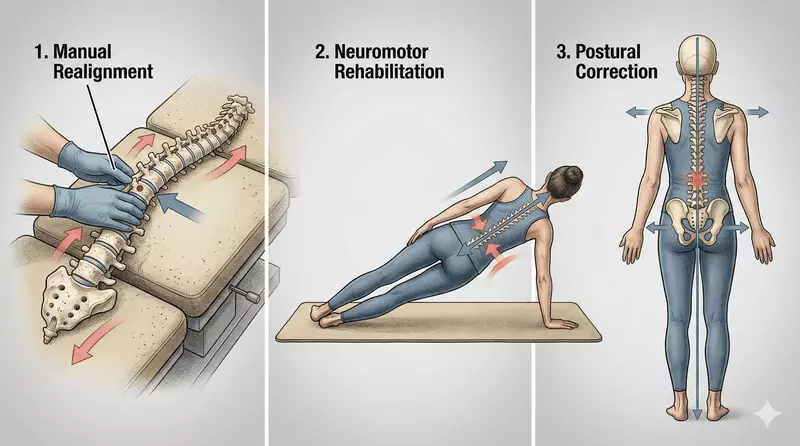
Our scoliosis care model is holistic, patient-specific, and rooted in clinical best practices—providing a non-surgical, conservative path to better spinal health.
Supporting Long-Term Scoliosis Outcomes
Scoliosis is a condition that evolves over time, making long-term management essential for maintaining spinal health, preventing curve progression, and preserving function. At Freedom Clinics, our approach is built around continuity of care, empowering patients to proactively manage their scoliosis through regular reassessment, maintenance chiropractic, and lifestyle alignment strategies.
Monitoring Curve Changes and Spinal Function
Subtle scoliosis progression often goes unnoticed—particularly in adults with degenerative scoliosis or individuals in sedentary roles. We conduct regular clinical reviews to track:
- Changes in spinal posture (e.g. pelvic tilt, rib cage rotation)
- Cobb angle progression (via collaborative imaging when necessary)
- Declines in functional mobility
- Increased muscle asymmetry or neuromuscular compensation

These evaluations allow us to make timely adjustments to your care plan and ensure long-term spinal alignment is preserved.
Preventive Chiropractic Care for Scoliosis Stability
Preventive chiropractic treatment is a cornerstone of our scoliosis maintenance strategy. Routine spinal care helps:
- Sustain joint mobility and flexibility
- Address minor alignment changes before they become symptomatic
- Support postural integrity and spinal load balance
- Reduce the risk of curve deterioration through proactive intervention
We personalise maintenance schedules based on:
- Scoliosis type (e.g. idiopathic vs degenerative)
- Lifestyle demands (e.g. desk-bound vs active occupations)
- Functional goals and previous curve behaviour
Lifestyle Strategies to Extend Spinal Longevity
Outside the clinic, your daily habits play a major role in scoliosis outcomes. Our chiropractors provide personalised lifestyle coaching that includes:
- Ergonomic workstation assessments
- Guidance on sleep posture and optimal mattress selection
- Prescribed mobility exercises to reduce myofascial tension
- Microbreak routines to prevent postural fatigue
- Core stabilisation drills to enhance spinal support
These strategies aim to maintain balance between muscular control, joint mobility, and biomechanical alignment, helping you stay mobile, strong, and resilient.
Consistent ergonomic habits are vital for long-term disc injury prevention and spinal health.
Building Long-Term Resilience Through Personalised Care
Sustaining scoliosis progress is about more than treating a curve—it’s about maintaining optimal function, preventing mechanical stress, and adapting care over time.
At Freedom Clinics, we commit to:
- Ongoing neuromuscular monitoring
- Regular reassessment to detect early changes
- Empowering you with movement education, tools, and support to manage scoliosis into the future
Why Choose Freedom Clinics for Scoliosis Chiropractic Care?
If you’re looking for an experienced, trusted, and conveniently located scoliosis chiropractor in Canary Wharf, Freedom Clinics is the leading choice for expert non-surgical scoliosis management in East London. Our clinic blends clinical precision, personalised treatment planning, and long-term spine health strategies to deliver consistent, measurable results.
We care for patients across the scoliosis spectrum:
- Idiopathic scoliosis in teens and adults
- Degenerative scoliosis related to aging and spinal wear
- Functional or postural scoliosis due to muscle imbalance
Specialist Chiropractic Training in Curve Management
Our chiropractors are skilled in curve-specific spinal correction protocols, using techniques adapted to your unique spine. With deep knowledge in:
- Postural biomechanics and curve pattern recognition
- Manual adjustments for spinal mobility and asymmetry
- Drop-table and activator methods for precision and safety
- Integration of rehabilitative exercise and ergonomic guidance
We align your care with both clinical best practices and your personal health goals, making Freedom Clinics one of London’s most reputable scoliosis-focused chiropractic centres.
Prime Location – Canary Wharf Scoliosis Clinic
Conveniently based in the Canada Place Shopping Mall, Freedom Clinics offers easy access to advanced chiropractic care for residents and professionals across Canary Wharf, Poplar, and the broader East London area.
Key location advantages:
- Direct transport links via Jubilee Line and DLR
- Early morning and weekend availability
- Located within a multidisciplinary healthcare hub
- On-site diagnostics and private treatment rooms
What Our Patients Say About Scoliosis Treatment at Freedom Clinics
Our patients consistently report:
- Improved spinal posture and symmetry
- Relief from chronic scoliosis-related discomfort
- Enhanced movement confidence and daily function
- Sustainable outcomes with minimal intervention
With a reputation built on results, compassionate care, and clinical integrity, we’ve become a trusted provider for patients seeking scoliosis support without surgery.
Ready to Take Control of Your Spinal Health?
Book a comprehensive scoliosis assessment with our expert chiropractors today. Whether you’re seeking a second opinion, have recently been diagnosed, or are looking for proactive support, we’re here to help.
Freedom Clinics – Canary Wharf
Canada Place Shopping Mall
34 North Colonnade
London E14 5HX
Call: 0203 197 9100
Email: canarywharf@freedomclinics.com
Opening Hours:
Mon–Fri: 7am – 8pm
Sat–Sun: 10am – 4pm


Our Chiropractors


References
- Morningstar M. W. (2011). Outcomes for adult scoliosis patients receiving chiropractic rehabilitation: a 24-month retrospective analysis. Journal of chiropractic medicine, 10(3), 179–184. https://doi.org/10.1016/j.jcm.2011.01.006
- Moreau, M. Schroth physiotherapeutic scoliosis-specific exercises for adolescent idiopathic scoliosis: how many patients require treatment to prevent one deterioration? – results from a randomized controlled trial – “SOSORT 2017 Award Winner.” Scoliosis and Spinal Disorders. https://doi.org/10.1186/S13013-017-0137-8
- Roberts, J. A., & Wolfe, T. M. (2012). Chiropractic management of a veteran with lower back pain associated with diffuse idiopathic skeletal hypertrophy and degenerative disk disease. Journal of chiropractic medicine, 11(4), 293–299. https://doi.org/10.1016/j.jcm.2012.10.007

