
Why Posture Matters
Posture is more than how you stand or sit — it is a dynamic reflection of your body’s structural balance, muscular function, and neurological coordination. At Freedom Clinics, we view postural alignment as a foundational indicator of musculoskeletal health, directly impacting how your body moves, performs, and feels.
Book your appointment
Proper posture supports your body’s biomechanical efficiency. When your spine is aligned, and your joints are in their optimal positions, the muscles, ligaments, and nervous system function with less strain, leading to:
- Reduced physical fatigue and muscle tension
- Decreased risk of repetitive strain injuries and chronic pain
- Improved mobility, balance, and movement control
- Enhanced breathing mechanics and organ function
- Greater energy efficiency during daily and athletic activities
On the other hand, poor posture contributes to a range of functional problems. Forward head carriage, rounded shoulders, and anterior pelvic tilt are common postural deviations that can lead to:
- Cervical and lumbar spine stress
- Tension headaches and TMJ discomfort
- Core instability and reduced proprioception
- Compensatory movement patterns that elevate injury risk
This makes posture more than a visual concern — it’s a clinical issue with systemic implications. Over time, postural dysfunction can affect not only your spinal structure but your neuromuscular coordination, breathing efficiency, and even mood regulation.
Chiropractors are uniquely positioned to assess and correct posture at both a structural and functional level. Using a blend of spinal assessment, movement screening, and targeted rehabilitation, our goal is not just to improve how you look when you stand — but how your body operates when you move.
Whether you’re sitting at a desk, lifting at the gym, or recovering from an injury, your posture plays a pivotal role in how well your body adapts and performs. That’s why understanding and optimising posture is central to any comprehensive approach to long-term chiropractic care.
What Is a Posture Assessment?
A posture assessment is a clinical diagnostic process used to evaluate how your body holds itself both at rest and in motion. At Freedom Clinics in Canary Wharf, our posture assessments go far beyond surface-level observations — they are a multidimensional analysis of your body’s spinal alignment, joint symmetry, and neuromuscular coordination.
The goal is to identify where postural imbalances, restrictions, or compensations exist, and how these may be contributing to pain, poor performance, or potential injury. We analyse not just what your posture looks like, but how it functions and adapts across different movement patterns.
According to the American Physical Therapy Association’s clinical practice guidelines, modern musculoskeletal assessment classifies patients by impairments such as limited range of motion, motor control deficits, and movement coordination impairments to link findings with pain and function. This impairment-based approach—endorsed in JOSPT’s 2017 Neck Pain and 2021 Low Back Pain guidelines—supports using a posture assessment to detect restrictions and compensations that drive symptoms and performance loss.
A Posture Assessment Typically Includes:
- Static alignment review of the spine, shoulders, pelvis, knees, and ankles
- Detection of common deviations such as forward head posture, kyphosis, scoliosis, and pelvic tilt
- Dynamic movement screening including walking, sitting, and transitional movements
- Measurement of joint mobility, flexibility, and spinal range of motion
- Muscular activation testing to determine overactive or underperforming stabilisers
- Ergonomic pattern analysis to uncover work, screen time, or lifestyle-related contributors
Each component contributes to a comprehensive postural profile, which maps how well your body maintains structural integrity in real-world contexts — from desk work to athletic performance.
Why Chiropractic Posture Assessments Stand Out
Unlike general fitness screenings or app-based tools, a chiropractic posture assessment is led by a practitioner trained in musculoskeletal pathology, spinal biomechanics, and nervous system function. This allows for:
- Identification of underlying causes of poor posture rather than just symptoms
- Integration of findings into a precise, evidence-based treatment plan
- Real-time correlation between structural findings and neurological function
- Recommendations that include manual therapy, corrective exercise, and ergonomic advice
Posture assessments are not just for those in pain. They are preventative tools that uncover movement inefficiencies, highlight areas of risk, and help patients proactively maintain spinal health over the long term.
Whether you’re struggling with recurring headaches, lower back tightness, or fatigue after prolonged sitting, a posture assessment is often the first step toward diagnosing the biomechanical root of your discomfort — and creating a pathway to correction and optimisation.

Who Should Consider a Posture Assessment?
A posture assessment is not just for individuals in pain or recovering from injury — it’s a diagnostic tool for anyone who wants to optimise how their body aligns, moves, and handles physical stress. Whether you’re seated at a desk for hours, training athletically, experiencing discomfort, or pursuing proactive wellness, a posture assessment provides clinical insight into your structural and functional health.
Desk-Based Professionals
People working in desk-based or screen-intensive environments are among the most common candidates for posture assessment. Poor workstation setup and sedentary patterns can lead to cumulative ergonomic strain, contributing to:
- Forward head posture caused by low screen positioning
- Rounded shoulders from extended keyboard or mouse use
- Lumbar compression due to lack of lower back support
- Prolonged static posture leading to joint stiffness and circulation issues
Posture assessments for desk workers include an ergonomic review, helping uncover how environmental factors are affecting spinal alignment, muscular fatigue, and movement efficiency. Early intervention can reduce postural decline and improve physical comfort throughout the workday.

Athletes and Physically Active Individuals
For athletes, posture plays a critical role in performance, injury prevention, and movement symmetry. Many active individuals unknowingly compensate for muscular imbalances or movement restrictions that impact training or competition outcomes.
A posture assessment offers:
- Detection of biomechanical imbalances impacting form and recovery
- Identification of range of motion (ROM) limitations in key joints
- Assessment of movement asymmetries during sport-specific activities
- Insights into postural compensation patterns from overuse or prior injury
Postural diagnostics give athletes a performance baseline, enabling more efficient training, reduced injury risk, and better long-term structural resilience.
Individuals Experiencing Pain or Discomfort
Chronic or recurring pain — especially in the neck, shoulders, back, or hips — is often related to postural dysfunction. A chiropractic posture assessment helps identify whether symptoms are the result of:
- Spinal misalignment contributing to joint compression or nerve irritation
- Muscle imbalance creating tension and mobility restriction
- Improper load distribution across the body during daily movement
- Referred pain from compensatory posture patterns
Rather than simply treating the symptoms, this type of assessment identifies the root cause, allowing for targeted intervention that restores balance and supports natural movement.
Preventive and Wellness-Focused Clients
Even in the absence of pain, a posture assessment can serve as a valuable preventive tool — ideal for those invested in long-term musculoskeletal health and functional wellbeing. This includes:
- Individuals starting a fitness or rehabilitation programme
- Clients concerned about tech posture and prolonged screen exposure
- People managing daily stress through movement-based wellness practices
- Anyone seeking to improve movement efficiency and prevent future injury
By establishing a posture and alignment baseline, this evaluation allows for smarter training, better ergonomic habits, and informed decisions about your physical health and lifestyle choices.
How the Posture Assessment Works
At Freedom Clinics in Canary Wharf, our posture assessment is a comprehensive, multi-step clinical evaluation designed to uncover the structural, functional, and environmental factors influencing your spinal health and movement efficiency. Far beyond a surface-level observation, it combines chiropractic diagnostic techniques with biomechanical screening and ergonomic analysis to deliver a personalised understanding of your posture.

Step 1: Clinical Consultation and History Review
The process begins with an in-depth consultation to establish your musculoskeletal background and identify relevant lifestyle factors. This includes:
- Discussion of current symptoms, chronic pain, or mobility concerns
- Analysis of lifestyle and occupational habits (e.g. prolonged sitting, physical activity)
- Review of medical and injury history
- Goal setting for posture correction, injury prevention, or movement improvement
This foundation ensures that your chiropractor can tailor the assessment to your specific needs and risk factors.
Step 2: Structural Alignment and Symmetry Analysis
Your chiropractor will then perform a visual and structural analysis to assess:
- Spinal alignment, including cervical, thoracic, and lumbar regions
- Postural symmetry, observing head, shoulder, and pelvic positioning
- Deviations such as anterior pelvic tilt, scoliosis, or postural shifts
- Weight-bearing patterns and how they impact joint load and balance
This phase helps identify imbalances in posture that may be contributing to pain, tension, or inefficient movement.
These findings sit within the bigger picture of comprehensive chiropractic care delivered at Freedom Clinics.
Step 3: Functional Movement and Biomechanical Screening
This stage evaluates how your posture functions during movement. Your chiropractor will observe:
- Gait and walking mechanics
- Balance and coordination during daily movements (e.g. sitting, standing, reaching)
- Core engagement and dynamic posture under light movement stress
- Transitional movement quality and signs of compensation
This biomechanical analysis links static posture to dynamic function, offering insights into performance and injury risk.
Your movement screen informs targeted rehab exercises that reinforce efficient, durable patterns.
Step 4: Range of Motion (ROM) Testing
Range of motion testing is used to determine flexibility and joint mobility across key areas:
- Neck (cervical spine) for turning and nodding
- Mid-back (thoracic spine) for twisting and bending
- Lower back (lumbar spine) for flexion and extension
- Hips and pelvis for rotation and load transfer
Limited ROM is a common indicator of postural restriction, muscular imbalance, or segmental spinal dysfunction.
A 2017 APTA/Orthopaedic Section decision tool lists limited cervical ROM and restricted segmental mobility as expected exam findings in mobility-related neck pain, reinforcing ROM loss as a clinically meaningful indicator; moreover, JOSPT reports the CROM device provides reliable cervical ROM measurements, allowing clinicians to quantify these restrictions objectively.
Quantifying restrictions helps us relate stiffness and mobility deficits to presentations like cervical neck pain.
Step 5: Muscle Activation and Neuromuscular Function
We assess how your postural muscles are working — and whether they’re compensating incorrectly. This includes:
- Identifying overactive vs underactive stabilisers
- Testing core vs extensor activation
- Evaluating neuromuscular coordination and proprioception
- Noting fatigue or over-recruitment patterns under stress
These insights help pinpoint the muscular imbalances and neural control issues that may be reinforcing poor posture.
Activation testing clarifies how scapular control issues can contribute to shoulder pain patterns.
Step 6: Ergonomic and Habitual Pattern Review
We review how your daily habits and environment affect your posture, focusing on:
- Desk ergonomics (monitor height, chair design, screen distance)
- Repetitive movements or static loading in your job or sport
- Tech usage habits and forward head posture from phone or screen time
- Sleep posture and other habitual influences
This stage supports the long-term sustainability of any posture correction by targeting root environmental causes.
Small changes to workstation ergonomics prevent the daily triggers that unravel posture between sessions.
Step 7: Personalised Posture Profile and Clinical Plan
All findings are consolidated into your personalised Posture Profile, which outlines:
- Alignment scores and asymmetry markers
- Range of motion metrics across spinal segments
- Identified muscle imbalances and compensation zones
- Functional risk factors based on lifestyle and movement habits
- A tailored chiropractic treatment plan, plus ergonomic and exercise recommendations
This profile gives you a clear, evidence-based understanding of your postural health and a roadmap for improvement.
Your Posture Profile then guides a personalised chiropractic treatment plan you can follow with confidence.
Posture Correction & Treatment Pathways
Following your posture assessment at Freedom Clinics in Canary Wharf, our team implements a personalised treatment pathway to correct structural imbalances, restore healthy spinal function, and reinforce sustainable posture. Your Posture Profile guides this integrated process, ensuring each intervention targets the root causes of your postural dysfunction.
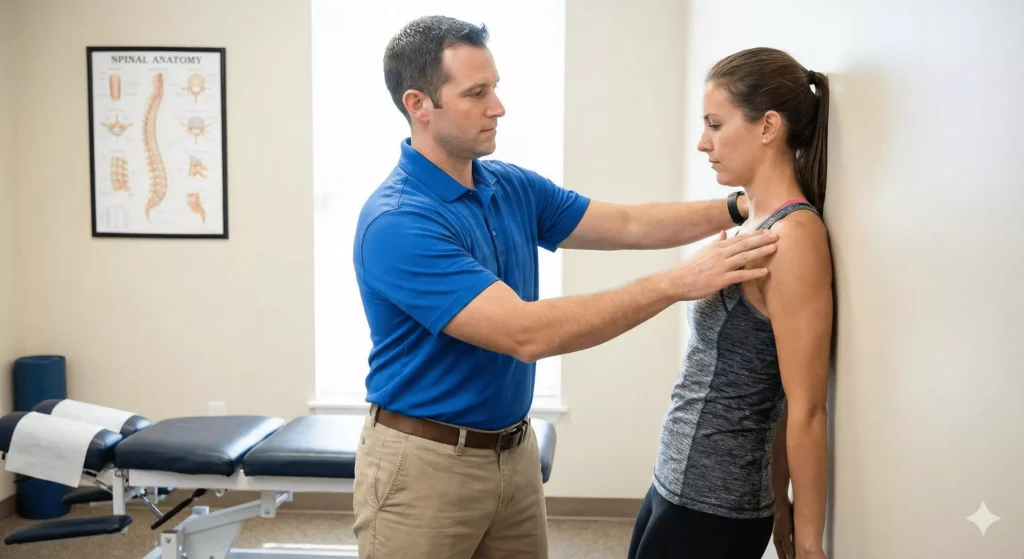
Chiropractic Adjustments: Realigning the Spine
Chiropractic adjustments are the cornerstone of posture correction. These gentle, precise techniques restore optimal spinal alignment, addressing the biomechanical foundations of poor posture. Adjustments are used to:
- Reposition misaligned vertebrae causing pelvic tilt, rounded shoulders, or forward head carriage
- Relieve pressure on spinal discs and nerve roots that contribute to muscular compensation
- Increase joint mobility in the cervical, thoracic, and lumbar spine
- Reinforce natural curvature and symmetrical posture
This intervention reestablishes structural integrity, enabling your body to support itself more efficiently throughout daily movement.
Restoring joint play reduces aberrant loading that can aggravate disc injury mechanics.
Postural Muscle Retraining: Building Neuromuscular Control
To maintain corrected posture, the body must relearn how to stabilise itself using the correct muscle groups. Our retraining protocols focus on:
- Activating underutilised postural stabilisers, such as the glutes, core, and deep cervical flexors
- Reprogramming movement patterns that have developed in response to chronic compensation
- Enhancing proprioception — the body’s awareness of position — to support long-term postural control
- Stretching and releasing overactive muscles (e.g. hip flexors, pectorals, upper trapezius) that reinforce poor posture
This neuromuscular re-education creates sustainable change, transforming posture from a conscious effort into a natural habit.
Ergonomic Optimisation: Correcting Daily Postural Triggers
Structural correction alone is not enough — true posture improvement requires environmental alignment. We address external contributors by:
- Assessing and correcting workstation ergonomics, including monitor height, seat angle, and lumbar support
- Advising on postural load during lifting, screen usage, and prolonged sitting
- Integrating micro-break strategies to minimise static load and encourage movement variability
- Modifying sleep posture and daily routines to reduce cumulative spinal stress
By redesigning your environment, we remove the repetitive stressors that lead to postural regression, making your improvements more durable.
Integrated Rehabilitation and Long-Term Monitoring
For complex or long-standing postural dysfunction, we offer a multi-disciplinary support model that includes:
- Rehabilitative exercises to build strength, endurance, and balance across postural chains
- Manual therapies such as massage or myofascial release to address deep-seated muscular tension
- Mobility programming to improve flexibility and joint function
- Scheduled reassessments to measure alignment changes, track progress, and refine your treatment plan
This approach ensures that posture correction is not a temporary fix — but a supported, measurable transformation with lasting impact.
Scheduled progress checks help you transition into chiropractic maintenance care for durable results.
By combining chiropractic intervention, postural muscle re-education, ergonomic correction, and integrated rehabilitation, Freedom Clinics delivers a complete pathway to structural health and movement efficiency. Whether your goal is pain relief, injury prevention, or performance enhancement, our treatment strategies are tailored to ensure your posture becomes your strongest asset.
Reviewed by Tanesa Mohan
FAQs, Benefits & Booking
Frequently Asked Questions
Is a posture assessment still valuable if I’m not experiencing pain?
Absolutely. Many structural issues develop long before symptoms appear. A chiropractic posture assessment helps identify subtle imbalances and musculoskeletal dysfunctions early, allowing for preventive care before discomfort, injury, or restricted movement occurs.
How long does posture correction take to see noticeable improvements?
Improvement timelines depend on the degree of postural dysfunction, daily habits, and adherence to care. While some patients report changes within a few sessions, sustained improvements often take 6–12 weeks of targeted chiropractic treatment, postural retraining, and ergonomic adjustments.
Does chiropractic treatment for posture involve pain or discomfort?
No. Chiropractic adjustments used in posture correction are gentle, precise, and designed to restore joint mobility without discomfort. Many patients experience immediate relief, enhanced range of motion, and improved posture after their sessions.
Will I need ongoing maintenance treatments to keep my posture corrected?
This varies by individual. Some patients maintain results through home exercises and ergonomic strategies. Others choose periodic chiropractic maintenance care as part of a proactive spinal health routine — especially those with physically demanding or sedentary lifestyles.
Can poor posture really affect my overall health and wellbeing?
Yes. Chronic poor posture is linked to fatigue, spinal tension, reduced lung capacity, digestive compression, and even mood disturbances. Correcting posture positively impacts both structural integrity and systemic function, improving energy, confidence, and mobility.
Benefits of Posture Assessment and Correction
- Early detection of musculoskeletal dysfunction
- Personalised chiropractic interventions to realign the spine
- Reduced muscle tension, stiffness, and postural fatigue
- Improved joint mobility, flexibility, and movement control
- Injury prevention across work, sport, and daily activity
- Enhanced breathing mechanics and core stability
- Increased energy, comfort, and body awareness
- Confidence from upright posture and improved self-presentation
Book Your Posture Assessment Today
At Freedom Clinics in Canary Wharf, we specialise in delivering evidence-based posture assessments and customised treatment pathways that target the root causes of poor alignment and movement dysfunction. Whether you’re experiencing pain, preparing for a fitness goal, or seeking preventive care, our team is here to help restore balance, posture, and performance.
Freedom Clinics
Canada Place Shopping Mall, 34 North Colonnade, Canary Wharf, London E14 5HX
0203 197 9100
canarywharf@freedomclinics.com
Open 7 days a week, early to late
Take the first step toward better posture and spinal health — book your consultation today.


Our Chiropractors


References
- Audette, I., et al. (2010). Validity and between-day reliability of the Cervical Range of Motion (CROM) device. Journal of Orthopaedic & Sports Physical Therapy, 40(5), 318–323. https://www.jospt.org/doi/10.2519/jospt.2010.3180
- Blanpied, P. R., et al. (2017). Neck pain: Revision 2017—Clinical practice guidelines linked to the ICF from the Orthopaedic Section of the APTA. Journal of Orthopaedic & Sports Physical Therapy, 47(7), A1–A83. https://www.jospt.org/doi/10.2519/jospt.2017.0302 — George, S. Z., et al. (2021). Interventions for the management of acute and chronic low back pain: Revision 2021 CPG from the APTA. Journal of Orthopaedic & Sports Physical Therapy, 51(11), CPG1–CPG60. https://www.jospt.org/doi/10.2519/jospt.2021.0304

