
Shoulder Pain Chiropractor – Canary Wharf
Shoulder pain is a common yet complex issue that affects people across all activity levels — from desk-bound professionals to elite athletes. At Freedom Clinics in Canary Wharf, our expert chiropractors specialise in diagnosing and treating the root causes of shoulder dysfunction, using advanced assessment tools and tailored rehabilitation programmes.
Whether you’re experiencing discomfort from a rotator cuff tear, impingement syndrome, frozen shoulder, or postural overload, early intervention is key. Left untreated, these conditions can lead to reduced range of motion, chronic inflammation, and long-term functional decline.
Medically Reviewed by the Freedom Clinics Chiropractic Team
Shahin Babayi, GCC Registration | Expertise: Spinal Mechanics & Acute Care
Tanesa Mohan, GCC Registration | Expertise: Diagnostic Differentiation & MSK Chain
This page has been collaboratively reviewed to ensure it reflects our integrated approach to shoulder health. We have verified the diagnostic markers for rotator cuff tears versus adhesive capsulitis and confirmed that all rehabilitation protocols meet current evidence-based safety standards.
Page updated: 14th April 2026
Book your appointment
Our Canary Wharf chiropractic team takes a comprehensive approach that considers joint mechanics, muscular imbalances, cervical and thoracic involvement, and movement patterns. We identify how factors like scapular instability, poor postural habits, or nerve referral from the cervical spine contribute to your pain.
By combining joint mobilisation, soft tissue therapy, neuromuscular retraining, and progressive rehabilitation exercises, we create a clear pathway to recovery — restoring mobility, reducing pain, and supporting long-term joint health.
Located inside Canada Place Shopping Mall, our clinic is easily accessible to those living or working in Canary Wharf, the City of London, or the wider East London area. Whether your goal is to return to sport, work without restriction, or simply sleep pain-free again, our team can help.
Understanding Shoulder Pain – Causes, Types & Symptoms
Shoulder pain can arise from a variety of musculoskeletal, neurological, or postural sources. At Freedom Clinics Canary Wharf, our chiropractors assess the full anatomical and functional picture to determine not just what hurts — but why it hurts. This allows for precise diagnosis and targeted intervention.
The shoulder is a complex joint system involving the glenohumeral joint, scapulothoracic articulation, clavicle, and surrounding soft tissue structures such as the rotator cuff, bursa, and labrum. Because of its mobility and functional demand, it’s prone to overuse, impingement, and instability.
Common Causes of Shoulder Pain:
- Rotator cuff injuries: Strains, tendinopathy, or tears affecting the supraspinatus, infraspinatus, teres minor, or subscapularis muscles.
- Impingement syndrome: Compression of soft tissues under the acromion during overhead movements.
- Frozen shoulder (adhesive capsulitis): Progressive stiffness and pain due to capsular inflammation and fibrosis.
- Postural dysfunction: Rounded shoulders, forward head posture, and scapular winging can all contribute to chronic shoulder stress.
- Cervical referral: Nerve root irritation from the neck (cervical spine) may mimic or amplify shoulder pain.
Typical Symptoms:
- Sharp, catching pain with arm elevation or rotation
- Dull aches during rest or sleep, especially when lying on the affected side
- Weakness, especially in lifting or reaching overhead
- Clicking, popping, or feeling of instability
Our chiropractors conduct a comprehensive physical examination, often including orthopaedic testing, postural assessment, range of motion analysis, and palpation of key anatomical landmarks. In more complex cases, we may coordinate with imaging centres for ultrasound or MRI if deeper structural insight is required.
By identifying the precise mechanism and classification of your shoulder pain, we can match you with the right treatment pathway — improving outcomes and minimising recovery time.
If you’re unsure of what’s causing your shoulder discomfort, our Canary Wharf chiropractic team can provide a clear diagnosis and a customised recovery plan.

Diagnostic Approach – How We Identify the Root Cause of Your Shoulder Pain
At Freedom Clinics Canary Wharf, we believe that effective shoulder pain treatment begins with precise diagnosis. Many patients present with overlapping symptoms — such as weakness, stiffness, or referred pain — which require in-depth assessment to determine the actual source of the issue.
Our chiropractors use a structured diagnostic process grounded in musculoskeletal and neurological examination principles. This helps us differentiate between joint, soft tissue, nerve, and postural dysfunctions.
What Our Shoulder Assessment Includes:
- Orthopaedic shoulder testing: We use special tests to detect issues such as rotator cuff tears, impingement, labral injury, and instability. These include Hawkins-Kennedy, Neer’s, Drop Arm, and Apprehension tests.
- Range of motion (ROM) analysis: We assess both active and passive ROM in the glenohumeral joint, scapulothoracic complex, and cervical spine to detect restrictions or asymmetries.
- Postural and biomechanical screening: Shoulder dysfunction often relates to poor posture or altered movement mechanics. We examine thoracic extension, scapular winging, head-forward posture, and muscle imbalances that may contribute to pain.
- Neurological testing: Nerve root compression or peripheral nerve entrapment may cause shoulder pain or referral patterns. We check for sensory loss, reflex changes, and nerve tension signs.
- Palpation of key structures: Our clinicians assess the rotator cuff tendons, AC joint, biceps tendon, scapula, and neck for tenderness, inflammation, or restriction.
When necessary, we refer for advanced imaging such as MRI or diagnostic ultrasound to confirm the presence of structural injuries like rotator cuff tears, bursitis, or labral lesions.
The American College of Radiology Appropriateness Criteria (2025) advise ultrasound or MRI for suspected rotator cuff tears and MRI/MR-arthrography for labral pathology when clinical examination suggests structural injury. This guidance from a leading radiology body supports your referral pathway for targeted imaging in complex or non-resolving cases.
“The Hitch Test” differentiating Frozen Shoulder from Tears.
So frozen shoulder is, basically it depends how many years it’s been there.
Usually I would say age of 55 and more.
You can tell if it’s frozen shoulder going on, and that is because it’s left it for a long time.
So when you’re bringing up your hands, for example, it just stops over there.
The first thing you tend to notice is you bring the shoulder and the neck together and okay that’s the first sign you see. It depends stage one, stage two, stage three when you bring neck and the shoulder together because it’s really frozen, it’s like an ice, so you’re bringing in the whole ice up and it would not move individually even the muscles as well. With a rotator cuff tear, it depends on which rotator cuff has been injured to begin with.
You will be able to move, range of motion will be good.
You can see that the joint is actually moving up, you’re not moving your neck and your shoulder blade together.
That’s rotator cuff. You usually feel around here or when you’re moving up, with, for example, kayaking. Yeah, or rowing, for example. That’s where you tend to feel a bit more, in a trigger scene. And from then, you kind of can tell, okay, from this test, it is rotator cuff tear rather than frozen shoulder.
The first thing you see, like I said, is bringing the whole movement up and down. Yeah.
Why This Matters:
A comprehensive diagnostic process ensures that we treat the cause, not just the symptoms. It also enables us to tailor your chiropractic care plan to your exact condition — whether you’re dealing with frozen shoulder, impingement, or a referral from the cervical spine.
With expert clinical reasoning and a hands-on approach, our Canary Wharf chiropractors provide clarity, direction, and confidence — setting the stage for targeted treatment and real results.
Expert Insight: The “Hitch” Test for Frozen Shoulder
"When diagnosing shoulder pain, I look for how the neck and shoulder move together. In a true Frozen Shoulder, the joint is essentially 'locked like ice'. Because the individual muscles and joint capsule can't move independently, you will see the patient 'hitch' their whole neck and shoulder upward just to lift their arm. In contrast, a Rotator Cuff Tear usually maintains a good range of motion, moving the joint without that compensatory neck hitch, though specific movements like kayaking or rowing will trigger sharp, localised pain."
Tanesa Mohan, Registered Chiropractor
What We Treat – Common Shoulder Injuries
At Freedom Clinics Canary Wharf, our chiropractors specialise in treating a broad spectrum of shoulder injuries. Whether you’re experiencing acute trauma or chronic strain, our goal is to identify the root issue and guide your recovery using evidence-based chiropractic care.
For a broader overview of conditions we help and how care is delivered, learn more about our Canary Wharf chiropractic clinic.
1. Rotator Cuff Injuries
Rotator cuff injuries are one of the most common causes of shoulder pain. These may include:
- Tendinopathy: Degeneration from repetitive loading, resulting in dull, aching pain and weakness.
- Partial or full-thickness tears: Often due to trauma or chronic overload.
- Subacromial bursitis: Inflammation caused by impingement or poor mechanics.
Our treatment approach focuses on reducing inflammation, restoring tendon integrity, and improving muscular coordination with soft tissue work, joint mobilisation, and rehabilitation exercises.
When tendon integrity is in question, we can arrange appropriate musculoskeletal imaging (X-ray & ultrasound) to clarify the diagnosis.
2. Shoulder Impingement Syndrome
This occurs when soft tissue structures — typically the rotator cuff or bursa — become compressed beneath the acromion during movement.
Symptoms often include a sharp pain in a specific range of motion, such as lifting the arm, and discomfort when lying on the shoulder. We address the issue by improving scapular control, thoracic posture, and decompression techniques to relieve the affected area.
If shoulder pain coexists with neck-driven symptoms, see our guidance on cervicogenic headache management and postural correction.
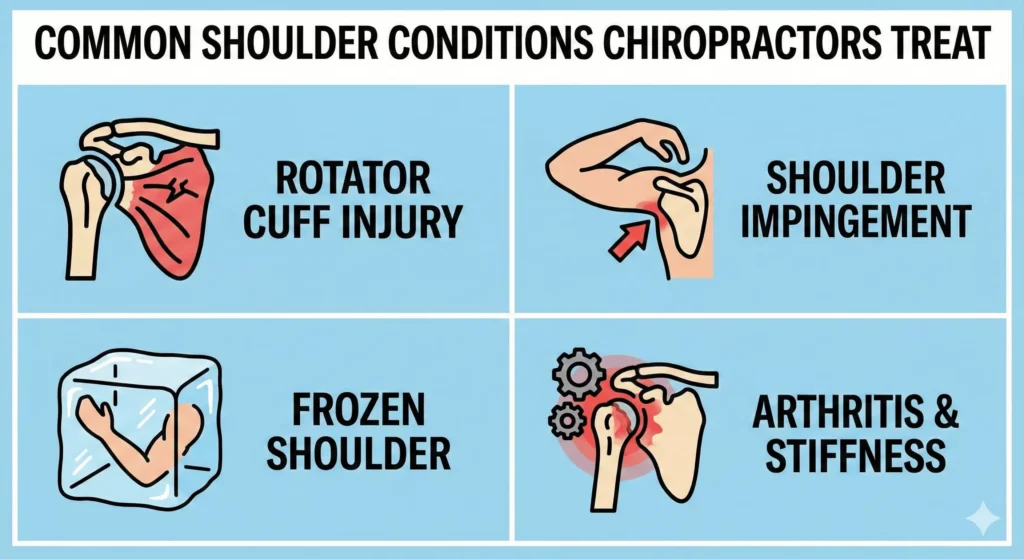
3. Frozen Shoulder (Adhesive Capsulitis)
Frozen shoulder is characterised by progressive stiffness and restricted mobility due to thickening of the joint capsule. It commonly progresses through three stages: freezing, frozen, and thawing. It is more common in individuals with diabetes, thyroid issues, or a history of immobility.
According to BMJ Open’s 2023 systematic review from researchers at the University of Oxford, people with diabetes have a significantly higher risk of developing adhesive capsulitis, while large cohort and case-control studies also associate thyroid disease with increased prevalence. This aligns with clinical observations that metabolic and endocrine factors heighten capsular inflammation and fibrosis, explaining why your history and screening capture diabetes and thyroid status as part of frozen-shoulder risk profiling.
Our chiropractors manage frozen shoulder with phase-appropriate strategies, including capsular mobilisation, stretching protocols, and functional retraining.
Your plan will progress through mobility, strengthening, and control; see how we structure a chiropractic treatment plan for frozen shoulder from start to finish.
The Clinical Reality of Frozen Shoulder Recovery
When it comes to shoulder pain or frozen shoulder in particular, there isn’t enough research or a fix that works with frozen shoulder.
It’s one of those things that comes and then eventually in a year or two it just goes. But there have been things that people have tried that gives them a lot of relief. Me as a chiropractor in particular, what I tend to look at is I also look at the spine because again, if you have a frozen shoulder what you tend to do is, you tend to compensate either with the neck to get a lot of movement or your mid-back. So again by addressing the mid-back and the neck we can give you some sort of a release or just give you some sort of a relief and at the same time we also have a look at the shoulder again at moving rehab, shockwave, laser whatever we can just to kind of get that joint moving.
But if I’m been totally honest with most frozen shoulders there isn’t much you can do because it goes away on its own eventually and no one knows why it comes and why it goes away. There’s no real evidence to indicate what’s causing it.
It’s just one of those if you’re unlucky to have it, you do get it.
You go through the three phases, which is pain, stiffness, and then the relief phase. It comes, it goes, and if you’re really unlucky in life, you get it on the other side, so it’s just that.
There are things you can do to help manage it, which is what we try to do, but there is no guaranteed treatment plan where it says, if you do this, it gets fixed, unfortunately, there isn’t one.
There are things we can do to just help minimise the discomfort at the shoulder moving if it works amazing if it doesn’t well just give it a bit more time. It’s almost like an autoimmune but it’s not really an autoimmune because there’s nothing in your blood or there’s nothing that you can check for to say that you’ve got frozen shoulder, it’s only diagnosed with, you know, you see a physio, you see a chiropractor, you can’t move, it’s this and that.
Symptoms match to what is usually presented as frozen shoulder and then you get the diagnosis. Some people do tend to get injections and that helps with the pain, but it doesn’t necessarily help with the stiffness.
There’s been, I think they’ve previously, they’ve had operations where they go in the shoulder, they dislocate them on purpose and pop it back in and hope in that would fix the problem. And I think there’s been very small success with that as well.
So I think the go to standard is you can have an injection if it really hurts and then you go away and wait for the pain to go away, do exercises, try and keep it as mobile and much as possible. And that’s it.
4. Shoulder Instability and Labral Tears
Shoulder instability may be traumatic (e.g., dislocation) or atraumatic (e.g., hypermobility or repetitive overhead activity). It often involves the glenoid labrum — a ring of cartilage that provides joint stability.
Symptoms may include clicking, apprehension during movement, or frequent subluxation. We use stabilisation drills, proprioceptive retraining, and neuromuscular activation to re-establish joint control.
To reinforce joint control between visits, follow our evidence-led scapular stabilisation rehab exercises.
5. Referred Shoulder Pain
Pain in the shoulder may originate from the cervical spine, thoracic outlet, or even internal organs. Cervical radiculopathy is a common culprit, presenting with radiating pain, tingling, or weakness.
Our chiropractors assess the entire kinetic chain, including the spine and nervous system, to ensure treatment addresses the true origin of your symptoms.
If assessment points to cervical referral, our dedicated resource on neck pain and cervical referral explains causes and options.
Chiropractic Treatment Approach – How We Relieve Shoulder Pain
At Freedom Clinics Canary Wharf, our chiropractic treatment approach targets the root causes of shoulder dysfunction — not just the symptoms. Our methods are grounded in evidence-based musculoskeletal care, integrating manual therapy, functional rehabilitation, and postural correction to restore optimal shoulder mechanics.
We understand that every shoulder pain presentation is unique. Some patients experience acute inflammation from rotator cuff injuries or bursitis, while others develop stiffness and weakness from chronic postural overload or adhesive capsulitis. That’s why we tailor each treatment plan using a multi-layered framework.
What Chiropractic Shoulder Treatment Involves:
- Joint Mobilisation & Manual Therapy
We use precise mobilisation techniques to restore movement in the glenohumeral joint, acromioclavicular joint, and thoracic spine. These adjustments help relieve capsular tension, decompress impinged tissues, and improve joint articulation. - Soft Tissue Techniques
Our chiropractors apply myofascial release, trigger point therapy, and cross-friction massage to address muscular tightness, adhesions, and inflammation around the rotator cuff, deltoid, and scapular stabilisers. - Neuromuscular Re-education
Postural imbalances and scapular dyskinesis are corrected through movement retraining. Exercises target deep stabilising muscles and promote scapulohumeral rhythm — essential for pain-free motion and long-term joint health. - Postural Correction & Ergonomic Advice
For patients with shoulder pain related to workstation setup or habitual movement patterns, we provide ergonomic guidance and exercises to reinforce healthy alignment and reduce mechanical load on the shoulder complex. - Rehabilitation & Strengthening
We build custom rehabilitation plans that guide recovery from acute injury through to functional strengthening. This may include resistance bands, proprioceptive drills, and mobility work tailored to your stage of recovery.
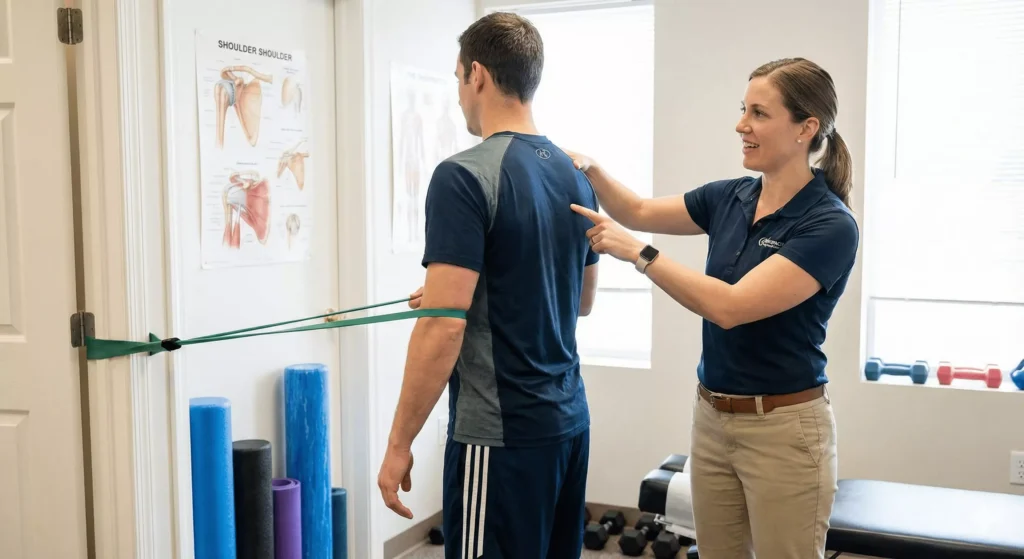
Our integrated chiropractic model ensures that each stage of healing — from inflammation control to functional return — is managed under one roof, with no referral delays or fragmented care.
Whether you’re recovering from a rotator cuff tear, managing chronic impingement, or restoring function after frozen shoulder, our Canary Wharf team provides expert, hands-on care for long-lasting relief and performance restoration.
Where symptoms involve nerve irritation from a disc, our page on cervical disc injury–related shoulder pain outlines red flags and recovery pathways.
Expert Insight: Why Your Spine Controls Your Shoulder Recovery
"Frozen shoulder is notoriously difficult to 'fix' quickly; research shows it can often take one to two years to fully resolve on its own. My priority is managing your compensation patterns. Because you can't move the shoulder, you instinctively overwork your neck and mid-back to get through the day. By adjusting the spine and using modalities like shockwave or laser therapy, we provide relief to those overworked areas and maintain mobility while the shoulder joint goes through its natural healing phases."
Shahin Babayi, Registered Chiropractor
Location, Booking & Contact — Freedom Clinics Canary Wharf
Whether you’re struggling with persistent shoulder pain, recovering from a rotator cuff injury, or experiencing mobility restrictions due to postural dysfunction, Freedom Clinics Canary Wharf is your destination for expert, accessible chiropractic care in the heart of London’s financial district.
Our Canary Wharf Clinic
Clinic Name: Freedom Clinics Canary Wharf
Address: Canada Place Shopping Mall, 34 North Colonnade, London E14 5HX
Location Highlights:
- Situated in the prestigious Canary Wharf estate
- Immediate access to Jubilee Line, Elizabeth Line, and DLR
- Located inside Canada Place, adjacent to Waitrose and Reebok Sports Club
This central London location makes our clinic ideal for professionals working in Docklands, the City, or surrounding boroughs.
Clinic Opening Hours
We provide early morning, evening, and weekend appointments to suit diverse schedules:
- Monday to Friday: 7:00 am – 8:00 pm
- Saturday: 10:00 am – 4:00 pm
- Sunday: 10:00 am – 4:00 pm
Book Your Shoulder Consultation
Phone: 0203 197 9100
Email: canarywharf@freedomclinics.com
Our online booking system allows you to secure appointments quickly — with many patients seen within the same week.
Why Choose Freedom Clinics Canary Wharf?
- Specialist Shoulder Chiropractors – With expertise in conditions like impingement syndrome, frozen shoulder, and cervical referral, our clinicians deliver focused, evidence-based care.
- Prime London Location – Easily accessible for commuters and city workers needing high-quality shoulder treatment near their workplace.
- Integrated Diagnosis & Treatment – Get assessed, treated, and rehabilitated without needing a GP referral.
- Late & Weekend Availability – Perfect for professionals seeking care outside of standard working hours.
Freedom Clinics Canary Wharf isn’t just a location — it’s a hub for expert musculoskeletal care, tailored recovery programmes, and long-term shoulder health.

Our Chiropractors


References
- Dyer, B. P., Gokhale, K., Sharma, M., Celik, O., Mendonca, R., & Prieto-Merino, D. (2023). Diabetes as a risk factor for the onset of frozen shoulder: A systematic review and meta-analysis. BMJ Open, 13(1), e062377. https://bmjopen.bmj.com/content/13/1/e062377
- Laur, O., et al. (2025). ACR Appropriateness Criteria®: Acute Shoulder Pain. Journal of the American College of Radiology. https://www.jacr.org/article/S1546-1440%2825%2900121-8/pdf

