
TMJ Disorder & Jaw Pain Treatment in Canary Wharf
Are you experiencing jaw pain when chewing, a clicking sound when opening your mouth, or persistent tension in your face and temples? These could be signs of Temporomandibular Joint Disorder (TMJD) — a condition that affects the function of your jaw joint and surrounding muscles.
At Freedom Clinics in Canary Wharf, our chiropractors take a comprehensive, evidence-informed approach to TMJD. We don’t just look at your jaw — we assess how postural strain, muscle tension, and cervical spine alignment may be contributing to your discomfort. Whether your jaw pain stems from bruxism (teeth grinding), poor posture, or muscular overload, we’ll help you move toward long-term relief with tailored chiropractic care.
Book your appointment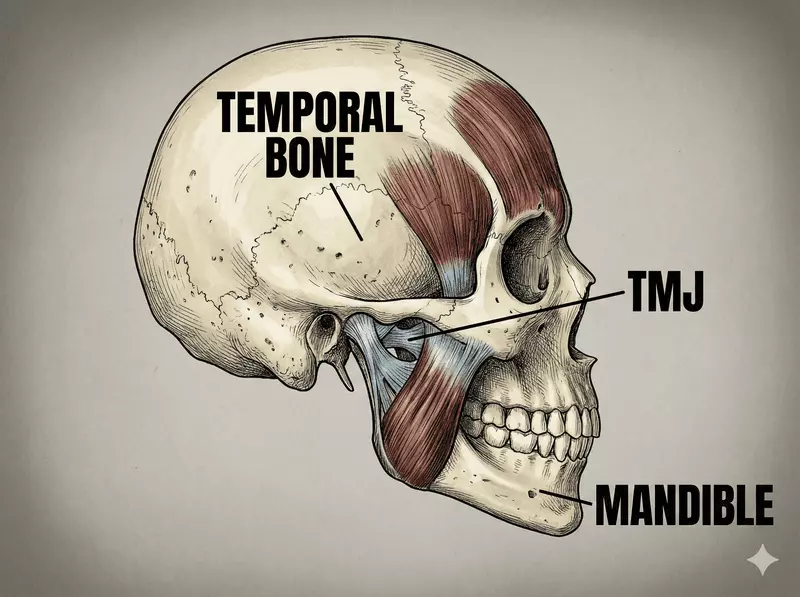
TMJ Disorder (TMD): Definition, Symptoms & Diagnosis
What is TMJ disorder and how does it affect jaw function?
The temporomandibular joint (TMJ) connects your jawbone to your skull and enables the essential movements of speaking, chewing, and yawning. When this joint or its associated muscles become dysfunctional — due to inflammation, misalignment, or overuse — it leads to Temporomandibular Joint Disorder (TMD).
TMJD can significantly affect jaw mechanics and quality of life. While dentists often manage bite-related causes, chiropractors focus on biomechanical imbalances, muscle dysfunction, and cervical spine compensation that influence TMJ function. If you’ve ever searched “what is TMJ disorder” or “how chiropractors treat TMJ,” this is where musculoskeletal care shines.
Recognising common TMJ symptoms
TMJD presents with a range of symptoms that often extend beyond the jaw. These include:
- Clicking or popping in the jaw during movement
- Locking of the jaw in an open or closed position
- Pain while chewing or speaking, often worse on one side
- Tension headaches, especially in the temples or forehead
- Ear pain, ringing, or a sense of pressure
- Neck pain or upper shoulder tension
These symptoms may be intermittent or constant, and are often influenced by posture, stress levels, and sleep position — making a full-body assessment critical for accurate diagnosis and effective treatment.
How chiropractors assess and diagnose TMJ dysfunction
If you’re wondering “how do chiropractors diagnose TMJ dysfunction?”, our approach is comprehensive and hands-on. At Freedom Clinics, we begin with a thorough history and examination, including:
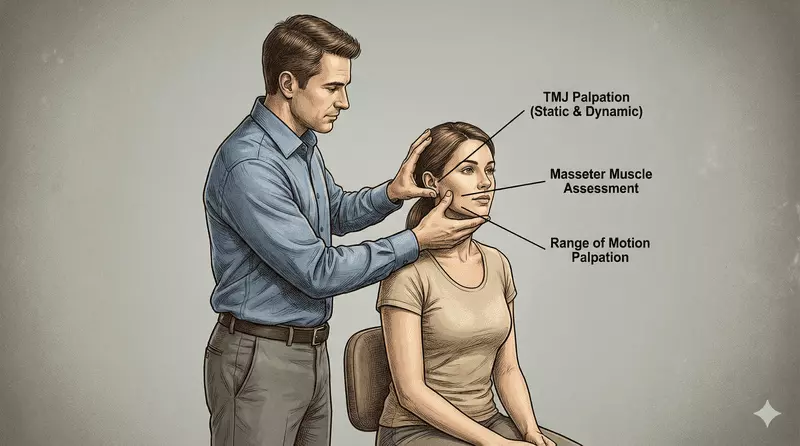
- Range of motion testing for the jaw — measuring opening, closing, and lateral movement
- Palpation of the jaw muscles, including the masseter, temporalis, and surrounding cervical musculature
- Postural analysis, focusing on head positioning, shoulder balance, and spinal alignment
- Screening for bruxism or habitual jaw clenching, often linked to stress
- Review of prior dental work, trauma, or repetitive habits like gum chewing
By understanding the mechanical, muscular, and behavioural contributors to TMJD, we can create a treatment plan that’s targeted, gentle, and designed for lasting change. Chiropractic care for TMJ disorder doesn’t just reduce symptoms — it addresses the root causes of dysfunction that conventional dental approaches may overlook.
What Causes TMJ Dysfunction? Bruxism, Posture & Stress
Understanding the root causes of Temporomandibular Joint Disorder (TMJD) is essential for both effective treatment and long-term relief. TMJD is not solely a dental concern — it’s a complex musculoskeletal condition often driven by muscle overuse, biomechanical misalignment, and behavioral tension patterns.
At Freedom Clinics, our chiropractic team takes a whole-body view of TMJ dysfunction. We commonly identify three overlapping causes that contribute to jaw pain and dysfunction: bruxism, poor posture, and emotional stress. These factors frequently interact, compounding the strain on the jaw joint and surrounding muscles.
Can Teeth Grinding Cause TMJ Pain?
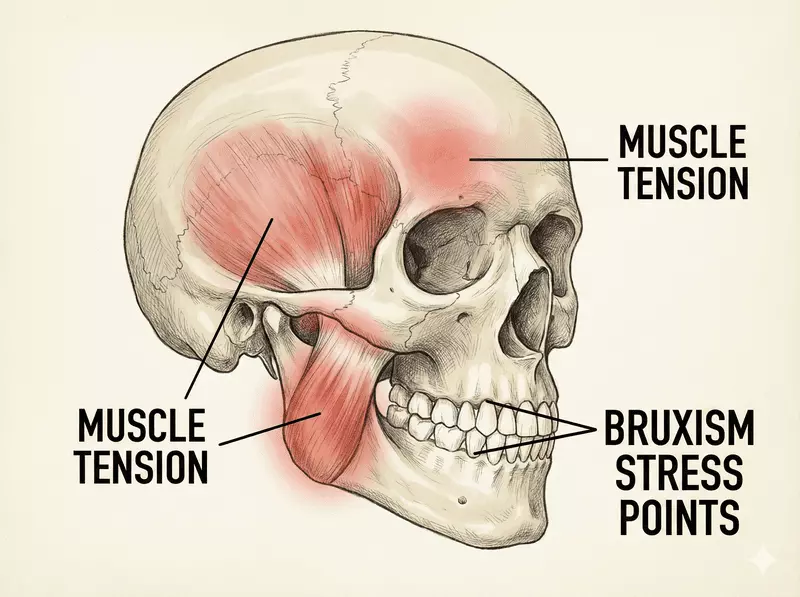
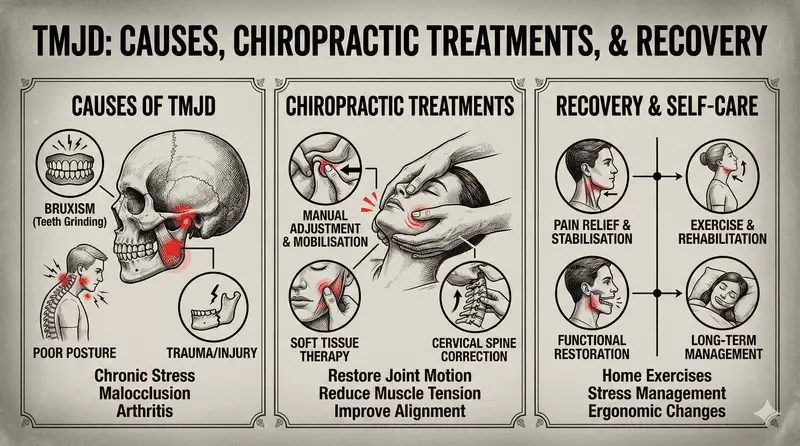
Yes — bruxism, or habitual teeth grinding and clenching, is one of the most common contributors to TMJ disorders. This often unconscious behavior exerts repeated stress on the masseter, temporalis, and pterygoid muscles, leading to chronic tightness and compression of the temporomandibular joint (TMJ).
If you wake up with a sore jaw, feel tension around your temples, or experience increased jaw pain during times of stress, bruxism may be the root cause. Over time, this muscle overload can cause:
- Inflammation of the TMJ
- Limited jaw movement
- Clicking or popping sounds
- Headaches or ear discomfort
Chiropractic treatment helps by addressing myofascial tension, joint compression, and the neuromuscular imbalances that drive this condition. We also explore the postural and behavioral factors that perpetuate bruxism.
How Does Posture Affect Jaw Alignment?
Poor posture — particularly forward head posture — can significantly affect jaw alignment and function. When the head shifts forward (as it often does during desk work or smartphone use), it pulls the jaw backward and downward, altering how the mandible aligns with the TMJ.
Research conducted at the Faculty of Health Sciences at the University of Ljubljana in 2021 found that forward head posture significantly alters the resting position of the mandible and increases spontaneous electrical activity in the masseter and temporalis muscles. These findings suggest that the biomechanical displacement of the head shifts the center of gravity, causing the jaw to be pulled into a suboptimal position that creates chronic mechanical stress and eventual dysfunction within the joint structure.
This results in:
- Abnormal jaw tracking
- Increased strain on the jaw and neck muscles
- Compensatory tightening of the shoulders and upper back
The structural relationship between the cervical spine and the jaw joint is often overlooked in traditional approaches to TMJD. Chiropractors are trained to detect and correct postural misalignments that impact jaw mechanics.
By restoring cervical and thoracic balance, we reduce unnecessary stress on the jaw and help patients move more comfortably and symmetrically.
Is Stress Making Your Jaw Pain Worse?
Yes — chronic emotional stress can directly contribute to TMJD by triggering jaw clenching, teeth grinding, and upper body tension. Many patients aren’t even aware of how often they hold tension in their jaw during the day — or how their stress translates into nocturnal bruxism.
Physiological effects of stress that can worsen TMJD include:
- Persistent muscle tension in the face and neck
- Shallow breathing and poor sleep posture
- Repetitive clenching during the day or night
At Freedom Clinics, we consider the psychophysical dimension of TMJD. Alongside chiropractic care, we guide patients in implementing relaxation techniques, breathing practices, and jaw awareness routines to reduce involuntary tension patterns.
Summary: The Three Key Drivers of TMJ Dysfunction
- Bruxism: Overworks the jaw muscles and compresses the TMJ
- Posture: Alters jaw alignment and increases cervical tension
- Stress: Triggers clenching and muscle guarding that worsen symptoms
By identifying these interconnected causes, our chiropractors create individualised TMJD treatment plans that target both the mechanical and behavioral roots of dysfunction. This integrative approach is what allows us to deliver more than just symptom relief — we help patients restore natural, pain-free movement in the jaw and neck.

TMJD Assessment: How Chiropractors Evaluate Jaw Dysfunction
Effective treatment for Temporomandibular Joint Disorder (TMJD) begins with a detailed and accurate assessment. At Freedom Clinics in Canary Wharf, our chiropractors evaluate not only the jaw joint itself, but also the muscular, postural, and spinal factors that commonly drive jaw dysfunction.
TMJD rarely exists in isolation. In many cases, jaw pain is influenced by cervical spine mechanics, forward head posture, muscle overactivity, or bruxism-related tension. That’s why chiropractic assessment focuses on how the jaw, neck, and upper body function together as a system.
How Do Chiropractors Assess TMJ Dysfunction?
Patients often ask, “How does a chiropractor assess TMJ disorder?”
Our approach is structured, hands-on, and designed to identify the root cause of jaw pain, not just the location of symptoms.
Your TMJD assessment at Freedom Clinics includes:
- Jaw range of motion testing
We assess how smoothly and symmetrically the jaw opens, closes, and moves side to side. Restricted movement or deviation often indicates joint tracking dysfunction. - TMJ joint palpation
The temporomandibular joint is examined for tenderness, clicking, locking, or uneven loading — all common signs of TMJ dysfunction. - Jaw and neck muscle assessment
Key muscles such as the masseter, temporalis, medial pterygoid, and sternocleidomastoid (SCM) are checked for tightness, guarding, or imbalance. These muscles are frequently overworked in people who clench or grind their teeth. - Cervical spine mobility testing
The upper neck plays a critical role in jaw positioning. Restricted movement or poor alignment in the cervical spine can directly affect jaw mechanics and muscle tone. - Postural analysis
We assess head position, shoulder alignment, and spinal posture. Forward head posture and rounded shoulders commonly increase strain on the jaw joint. - Bruxism and habit screening
We identify signs of teeth grinding, jaw clenching, nail biting, or sustained jaw tension — behaviours that maintain TMJD even in the absence of injury.
Restricted movement or deviation often indicates joint tracking dysfunction. According to clinical research from the Department of Prosthodontics at Tokyo Medical and Dental University, abnormal mandibular movement patterns—such as deviation during opening—are strongly associated with internal derangements of the temporomandibular joint, including disc displacement and impaired joint tracking.
Why Chiropractic TMJ Assessment Is Different
Chiropractors assess TMJD through the lens of functional biomechanics. Rather than isolating the jaw, we examine how posture, spinal alignment, and neuromuscular control influence jaw movement.
This allows us to determine whether your TMJ symptoms are being driven by:
- Cervical spine dysfunction altering jaw position
- Muscle overcompensation from chronic tension or stress
- Postural distortion changing how the jaw loads during movement
- Behavioural patterns such as daytime clenching or nocturnal bruxism
By identifying these relationships, we can distinguish between local joint irritation and global movement dysfunction, leading to more effective and lasting outcomes.
From Assessment to Action: Your TMJD Treatment Plan
Once your assessment is complete, your chiropractor will explain the findings clearly and outline a personalised TMJD care plan. This may include:
- Gentle TMJ mobilisation to improve joint movement
- Soft tissue therapy to reduce muscle tension in the jaw and neck
- Posture correction strategies to reduce cervical strain
- Bruxism management guidance to limit ongoing joint stress
- Targeted exercises to restore control and prevent recurrence
Every TMJD treatment plan at Freedom Clinics is individualised, evidence‑informed, and designed to evolve as your jaw function improves.
Chiropractic TMJ Treatments: Mobilisation, Soft Tissue & Posture Correction
Chiropractic treatment for Temporomandibular Joint Disorder (TMJD) at Freedom Clinics focuses on correcting the underlying biomechanical and neuromuscular causes of jaw dysfunction. Unlike approaches that treat TMJD solely as a dental issue, we evaluate how your jaw joint, muscles, and postural system interact — and then apply targeted therapies to restore balance.
Our TMJ care is hands-on, personalised, and non-invasive. We use a combination of joint mobilisation, soft tissue therapy, postural correction, and adjunctive techniques to reduce pain, improve movement, and prevent recurrence.
How Does Chiropractic Treat TMJ Disorder?
Patients often ask, “How does a chiropractor treat TMJ pain?”
Our approach begins by identifying which factors — joint restriction, muscle tension, postural misalignment, or bruxism — are contributing to your TMJD.
Based on your assessment, we develop a tailored plan to improve joint function, relieve muscle overuse, and correct structural imbalances that strain the jaw.
TMJ Joint Mobilisation: Restoring Smooth Movement
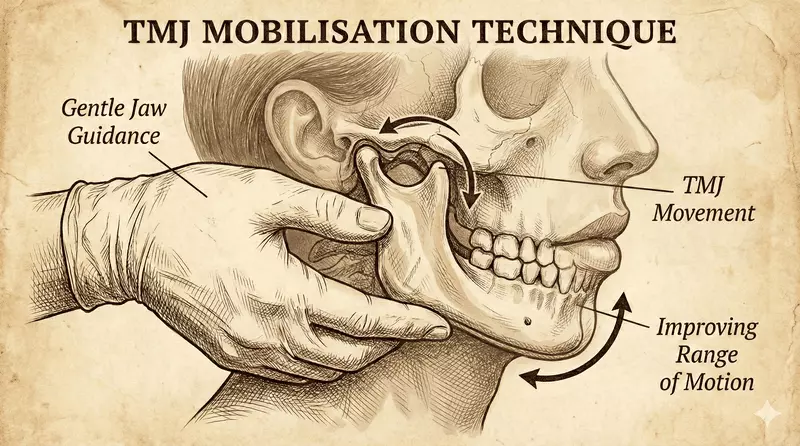
When the temporomandibular joint (TMJ) becomes stiff or misaligned, it disrupts the natural glide and hinge action needed for chewing, speaking, and yawning. We use gentle chiropractic joint mobilisation techniques to:
- Restore jaw range of motion
- Reduce clicking, locking, or catching
- Improve TMJ tracking and alignment
- Relieve pressure on inflamed tissues
TMJ mobilisation is ideal for patients experiencing jaw stiffness, asymmetrical movement, or discomfort during opening and closing.
Soft Tissue Therapy: Releasing Jaw Muscle Tension
Many TMJD symptoms stem from overactivity in the muscles that control jaw movement — especially the masseter, temporalis, and pterygoids. Chronic clenching or grinding (bruxism) causes these muscles to tighten and form trigger points that radiate pain to the jaw, head, and neck.
Our chiropractors apply targeted soft tissue techniques to:
- Reduce muscle tension and overactivity
- Release myofascial trigger points
- Restore flexibility to the jaw and neck
- Improve local circulation for healing
This approach is especially helpful if you suffer from jaw fatigue, facial tightness, or temporal headaches linked to TMJD.
This approach is especially helpful if you suffer from jaw fatigue, facial tightness, or temporal headaches linked to TMJD while addressing associated shoulder pain.

Postural Correction: Addressing the Structural Source
Your jaw doesn’t operate in isolation. Forward head posture, shoulder imbalance, and spinal misalignment can all place excess tension on the TMJ system. To treat these underlying drivers, we integrate:
- Cervical spine adjustments (where safe and appropriate)
- Exercises to improve scapular stability and thoracic extension
- Postural taping for proprioceptive awareness
- Ergonomic coaching to reduce strain during daily activities
By improving postural alignment, we help offload the jaw, allowing for more efficient movement and less muscular compensation.
By improving postural alignment, we help offload the jaw, allowing for more efficient movement and less muscular compensation within our comprehensive approach to neck pain.
Adjunctive Therapies to Support Your Recovery
Your plan may also include:
- Jaw mobility exercises to retrain movement patterns
- Relaxation training for stress-induced jaw clenching
- Breathing pattern correction to reduce upper body tension
- Cryotherapy or neuromuscular taping to reduce inflammation
These techniques complement our core chiropractic methods and are selected based on your needs and treatment goals.
Your Personalised TMJ Treatment Plan
Every TMJD case is different — and so is every plan we design. Whether you’re dealing with jaw clicking, chewing pain, or tension from bruxism, our chiropractors work with you to create a targeted, progressive programme that brings relief and lasting improvement.
If you’re looking for TMJ chiropractic treatment near Canary Wharf, we’re here to help you regain function, reduce pain, and restore balance across your jaw, neck, and posture.
TMJ Exercises, Posture Correction & Self-Care for Long-Term Relief
Successful treatment of Temporomandibular Joint Disorder (TMJD) extends beyond the clinic. To achieve lasting relief, patients must actively support their recovery through targeted exercises, postural awareness, and daily self-care strategies that reduce strain on the jaw joint, facial muscles, and cervical spine.
At Freedom Clinics, we equip every TMJD patient with a personalised at-home care plan that complements hands-on chiropractic treatment — helping you stay in control of your healing journey.
Jaw Exercises for TMJ Pain Relief and Function
One of the most effective ways to improve jaw mobility and reduce joint discomfort is through structured jaw exercises. These movements retrain neuromuscular patterns, restore balance across the TMJ, and reduce muscle tension in the masseter, temporalis, and pterygoid muscles.
Recommended TMJ mobility exercises:
- Tongue-up controlled opening
Encourages midline jaw tracking and prevents lateral deviation - Isometric resistance exercises
Strengthen and stabilise jaw movement against light resistance - Lateral glides
Improve coordination and flexibility in the muscles that guide side-to-side motion
These exercises are taught and supervised during in-clinic sessions, then adapted for daily home use — forming a foundation for restoring smooth, pain-free jaw function.
Posture Correction: Reducing Strain on the Jaw and Neck
Poor posture, particularly forward head posture, alters the mechanics of the jaw and increases loading through the temporomandibular joint and cervical spine. Over time, this can contribute to TMJD symptoms like clicking, tightness, and difficulty chewing.
We support patients with posture-focused rehabilitation that includes:
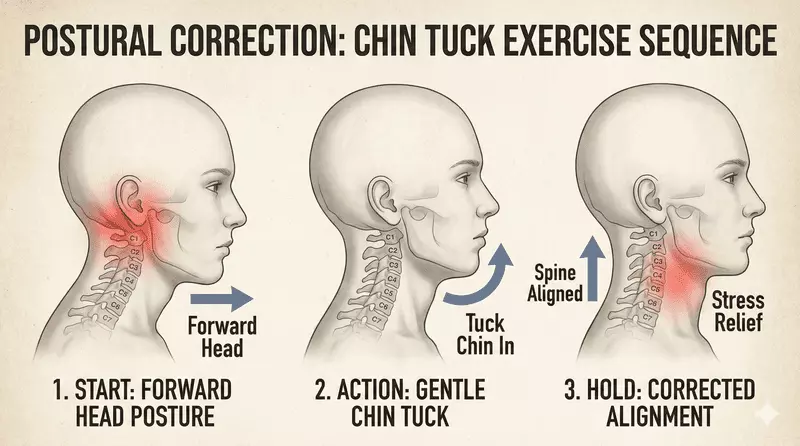
- Chin tucks and deep neck flexor activation
Realigns the head over the spine to reduce mandibular tension - Thoracic extension and scapular retraction drills
Improve shoulder posture and reduce compensatory strain on the jaw - Ergonomic coaching
Tailored guidance for your workstation, sleep position, and day-to-day movement habits
Postural correction not only reduces current TMJD symptoms — it also helps prevent them from returning by addressing the mechanical drivers of jaw dysfunction.
Postural correction not only reduces current TMJD symptoms — it also helps prevent them from returning by addressing the mechanical drivers of jaw dysfunction and mitigating chronic back pain.
Self-Care Strategies for Jaw Health and Bruxism Control
True TMJD management also involves behaviour change. We help patients implement jaw-friendly lifestyle habits to minimise aggravation and promote healing.
Jaw relaxation & awareness techniques:
- “Lips closed, teeth apart” rule
Reduces unnecessary pressure through the jaw throughout the day - Tongue-to-palate rest position
Supports natural jaw alignment and reduces fatigue - Tension scanning and release techniques
Increase awareness of clenching before it causes flare-ups

Bruxism management and stress control:
- Identify and break patterns of daytime clenching or grinding
- Use reminders and body scanning to interrupt unconscious habits
- Practice breathing exercises, mindfulness, and stress relief routines to reduce sympathetic nervous system dominance
Sleep & environmental adjustments:
- Optimise pillow support to protect the jaw during sleep
- Avoid pressure on the side of the face or stomach sleeping
- Consider additional support tools for night-time bruxism, if needed
When these strategies are practiced consistently, they can dramatically reduce the frequency and intensity of TMJD symptoms — and help you maintain the benefits of chiropractic care long after treatment ends.
Empowering Long-Term TMJ Recovery
The key to overcoming TMJD is integration: combining expert care with consistent self-management. At Freedom Clinics, we don’t just treat jaw pain — we help you understand it, manage it, and build resilience against it.
Through:
- Corrective exercises
- Postural training
- Jaw relaxation habits
- Stress and bruxism regulation
…you’ll not only relieve your current symptoms but take meaningful steps toward lasting jaw stability, muscle harmony, and postural balance.
TMJD Chiropractic Treatment: Results, Timeline & Expectations
Starting chiropractic treatment for Temporomandibular Joint Disorder (TMJD) is an important step toward restoring comfortable, efficient jaw movement. At Freedom Clinics, care is structured to address the mechanical, muscular, postural, and behavioural factors that drive jaw dysfunction, rather than simply masking symptoms.
Understanding what to expect from treatment helps set realistic goals and supports better long‑term outcomes.
How Long Does Chiropractic Treatment Take to Improve TMJD?
One of the most common questions we hear is:
“How long does it take for chiropractic care to help TMJ disorder?”
Most patients notice measurable improvements within 3 to 5 sessions. The exact timeline depends on several factors, including:
- The severity of jaw joint restriction, clicking, or locking
- Whether bruxism (teeth grinding or clenching) is present
- The degree of postural imbalance or cervical spine involvement
- How long symptoms have been present
- Previous trauma, dental procedures, or orthodontic changes
Acute or posture‑related TMJD often responds quickly. Long‑standing or stress‑driven cases may require a longer, progressive course of care to fully resolve underlying dysfunction.
What Improvements Should You Expect from TMJ Chiropractic Care?
TMJD improvement typically occurs in stages rather than all at once. As treatment progresses, patients commonly report:
- Smoother jaw opening and closing, with less deviation
- Reduced clicking, popping, or catching sensations
- Fewer episodes of jaw locking
- Decreased jaw clenching, especially in the morning
- Less facial tightness, neck tension, or headache frequency
- Improved posture and head positioning, reducing jaw strain
These changes reflect both local improvements in TMJ mechanics and broader improvements in muscle coordination and postural control.
We reassess regularly to ensure progress is objective, measurable, and aligned with your functional goals.
What Happens If TMJD Symptoms Do Not Improve?
While the majority of TMJD cases respond well to chiropractic care, some situations require additional investigation or collaborative management.
If symptoms plateau or fail to improve, we may recommend:
- Dental assessment for night guards or bite‑related contributors
- Imaging (MRI or X‑ray) to evaluate joint structures or disc position
- Referral to an oral health specialist for complex or non‑mechanical cases
This referral process ensures that TMJD care remains safe, appropriate, and evidence‑based, with chiropractic treatment forming part of a wider care pathway when needed.
This referral process ensures that TMJD care remains safe, appropriate, and evidence-based, with chiropractic treatment forming part of a wider care pathway when evaluating suspected disc injury.
Ongoing Care and Long‑Term TMJ Stability
Once symptoms have settled and jaw function has improved, the focus shifts to maintenance and prevention. This may include:
- Periodic check‑ins to monitor jaw movement and posture
- Reinforcement of home exercises and self‑care strategies
- Support for managing stress‑related clenching or bruxism
- Postural guidance to prevent recurring jaw overload
The goal is not just short‑term pain relief, but lasting stability of the jaw, neck, and postural system.
Frequently Asked Questions: TMJ Disorder & Chiropractic Treatment
This FAQ section addresses common patient concerns about Temporomandibular Joint Disorder (TMJD) and how chiropractic care can help. By integrating key entities, query-aligned phrasing, and predicate-based relationships, it ensures maximum visibility and semantic relevance.
Can chiropractic care help with TMJ disorder?
Yes. Chiropractic care is effective for TMJD, especially when symptoms involve jaw muscle tension, postural misalignment, or cervical spine dysfunction. Techniques such as TMJ mobilisation, soft tissue therapy, and posture correction exercises improve jaw function, reduce clicking and locking, and relieve associated headaches and neck pain.
Is TMJ treatment painful?
No. Our TMJD treatments are gentle and patient-centered, focusing on comfort while restoring jaw mobility and relieving muscle tension. Procedures like joint mobilisation, soft tissue release, and rehabilitative exercises are designed to minimise discomfort.
How long does chiropractic TMJ care take to show results?
Patients typically notice improvement within 3–5 sessions, depending on:
- Severity of jaw joint restriction, clicking, or locking
- Presence of bruxism or chronic muscle tension
- Degree of postural imbalance or cervical spine involvement
- Duration and history of symptoms
Chronic or multifactorial TMJD may require a progressive care plan to fully address the underlying causes.
Do I need to see a dentist along with chiropractic care?
Sometimes. While chiropractic care targets musculoskeletal and postural contributors, a dentist may be involved if bite misalignment or night guards are needed. We coordinate with dental and oral health specialists for a multidisciplinary TMJD approach.
Can posture affect TMJ symptoms?
Absolutely. Forward head posture and spinal misalignment alter jaw mechanics, increasing tension in the masseter, temporalis, and pterygoid muscles. Correcting posture via chiropractic treatment and exercises reduces jaw strain, improves range of motion, and decreases clicking and locking episodes.
Correcting posture via chiropractic treatment and exercises reduces jaw strain, improves range of motion, and decreases clicking and locking episodes through expert chiropractic guidance.
What should I do if my jaw locks or clicks frequently?
Frequent locking or clicking is a common sign of TMJD. Chiropractic assessment identifies whether the cause is joint restriction, muscle imbalance, or postural dysfunction. Early intervention with manual therapy, soft tissue release, and home exercises restores smooth jaw movement and reduces recurrence.
Can stress or bruxism worsen TMJD?
Yes. Stress and bruxism (teeth grinding or clenching) increase tension in the jaw muscles and exacerbate TMJD. Chiropractic care combined with jaw relaxation techniques, postural exercises, and stress management helps restore function and reduces flare-ups.
How can I maintain long-term TMJ health after treatment?
Long-term TMJD management relies on:
- Continuing jaw mobility exercises
- Maintaining postural awareness
- Practicing stress reduction and bruxism prevention strategies
- Performing home self-care routines
- Periodic chiropractic check-ins to ensure jaw stability
Consistent application of these strategies helps sustain jaw comfort, alignment, and function, while reducing the risk of recurrence.

Our Chiropractors


References
- Goto, T. K., Nishida, S., Nakayama, E., Nakamura, Y., Sakai, S., Yabuuchi, H., & Yoshiura, K. (2005). Correlation of mandibular deviation with temporomandibular joint MR dimensions, MR disk position, and clinical symptoms. Oral surgery, oral medicine, oral pathology, oral radiology, and endodontics, 100(6), 743–749. https://doi.org/10.1016/j.tripleo.2005.05.063
- Xu, G., Meng, C., Mao, J., & Zhang, J. (2021). Head and neck posture influences masticatory muscle electromyographic amplitude in healthy subjects and patients with temporomandibular disorder: a preliminary study. Annals of Palliative Medicine, https://apm.amegroups.org/article/view/63930

