
What to Expect at Your First Chiropractic Visit
Your first chiropractic visit at Freedom Clinics, Canary Wharf, is designed to be both welcoming and informative. It’s the foundation of a patient-centred care journey focused on understanding your unique needs, addressing your health concerns, and building a personalised treatment plan that prioritises results.
Book your appointment
A Calm, Professional Welcome
From the moment you walk into our clinic, you’ll be welcomed by our experienced front-desk team who will guide you through the initial steps. You’ll be asked to complete a health intake form that captures essential details about your medical history, lifestyle habits, previous injuries, and any current symptoms. This information allows your chiropractor to gain a comprehensive understanding of your health background and goals.
If you’ve booked your appointment online, you may have already completed some of these details in advance. Either way, we ensure the process is smooth, respectful of your time, and tailored to your experience level with chiropractic care — whether you’re brand new or returning to treatment.
Setting Expectations and Goals
During your check-in, we also help you clarify what you hope to achieve from chiropractic care. Whether it’s pain relief, better posture, injury prevention, or improving your overall mobility, your chiropractor will use these insights to shape the course of your initial consultation and ongoing treatment plan.
You’ll have the opportunity to ask any early questions about chiropractic methods, clinic procedures, or what will happen during the session. We prioritise clear communication and transparency to help you feel confident and in control.
Building the Foundation of Your Care Journey
This initial administrative and conversational phase is more than paperwork — it’s the starting point of a collaborative relationship with your chiropractor. Every form, question, and comment helps us understand how best to support your recovery and long-term spinal health.
Your Initial Consultation: Intake & Case History
After completing your intake form, your chiropractor will begin a one-on-one consultation designed to build a detailed picture of your current health, spinal concerns, and lifestyle. This is where we translate your answers into meaningful clinical insights and begin developing a care strategy that’s tailored to your body, goals, and daily life.
Discussing Your Health History and Chiropractic Goals
Your chiropractor will ask focused questions about your:
- Past injuries, accidents, or surgeries
- History of back pain, neck tension, headaches, or joint discomfort
- Work environment, posture habits, physical activity, and stress levels
- Sleep quality, diet, and daily routines that may affect spinal health
The purpose of this conversation is not just to identify your current symptoms but to explore contributing patterns. Even long-standing issues can often be traced back to overlooked postural habits, lifestyle strain, or previous traumas.
Whether you’re seeking relief from chronic discomfort or looking to improve mobility and prevent future issues, this consultation gives your chiropractor the context they need to guide your care responsibly and effectively.
Clarifying Symptoms and Setting Priorities
During this consultation, your chiropractor will work with you to prioritise your concerns. You’ll be encouraged to describe when your symptoms began, what makes them better or worse, and how they impact your daily life. This symptom mapping is essential for building both diagnostic clarity and a treatment plan that reflects your real-world needs.
This phase also allows for open dialogue about your preferences and concerns around treatment. Whether you’re nervous about spinal adjustments, interested in alternative techniques, or simply curious about how chiropractic care works, your chiropractor is there to answer questions with transparency and care.
A Patient-Centred Foundation
At Freedom Clinics, this stage is about more than gathering facts — it’s about building a relationship. Your initial consultation is the first step in a care journey rooted in partnership, communication, and clinical expertise. The more we understand your health story, the more precise and impactful your treatment will be.
Physical Examination: Assessing Your Posture & Movement
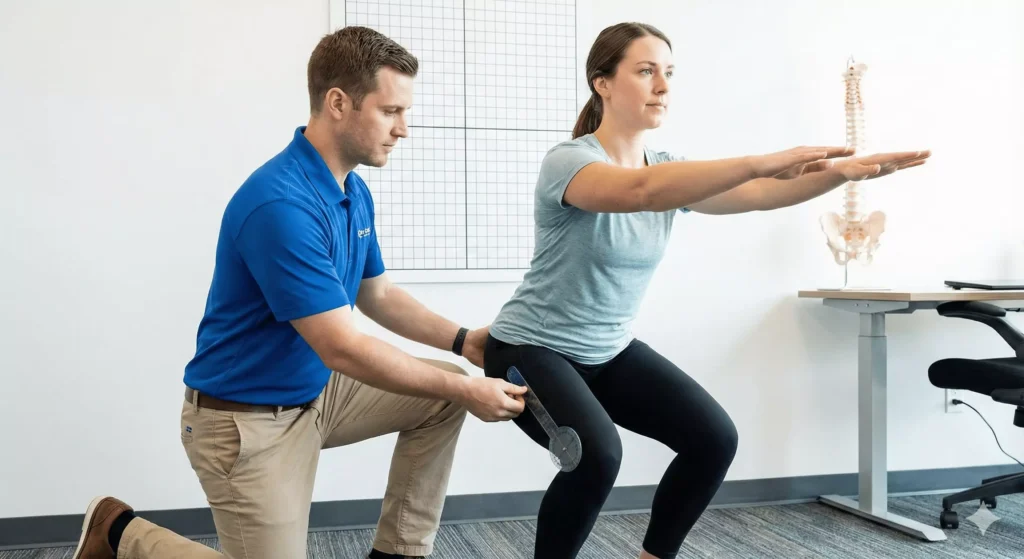
After your consultation, your chiropractor will conduct a thorough physical examination. This hands-on assessment is a critical step in identifying postural imbalances, joint restrictions, and nerve-related dysfunctions. The findings from this exam directly shape your personalised treatment plan.
Evaluate Posture and Alignment
The examination begins with a posture assessment. Your chiropractor will analyse your spinal alignment, shoulder and pelvic symmetry, and the overall structure of your standing and walking posture. By observing how your body holds and moves itself, the chiropractor can identify misalignments, muscle imbalances, and compensatory movement patterns that often underlie discomfort or dysfunction.
This posture evaluation helps uncover the biomechanical causes of pain, stiffness, or reduced mobility and allows your chiropractor to prioritise areas for correction.
Test Range of Motion and Gait
Next, your chiropractor will assess your range of motion through guided movements. You may be asked to bend, twist, or stretch in specific directions while the practitioner observes any restrictions or discomfort. Gait analysis may also be performed to evaluate how you walk, step, and transfer weight from one side to the other. This dynamic movement analysis helps identify abnormal patterns or compensations caused by joint limitations or muscular tightness.
These findings allow your chiropractor to determine which areas require manual therapy or mobilisations.
Perform Neurological and Orthopaedic Tests
In some cases, neurological screening is carried out to assess how your nerves are functioning. Your chiropractor may test reflexes, sensation, muscle strength, and coordination to rule out nerve involvement or underlying neurological conditions. Orthopaedic tests may also be performed to isolate specific structures such as discs, ligaments, or facet joints, helping to clarify whether pain is mechanical or structural.
These assessments are important for establishing a safe and effective treatment path, particularly for new patients with complex histories or persistent symptoms.
NICE clinical guidance advises a focused neurological examination (reflexes, strength, sensation) and the straight-leg-raise test to assess possible nerve root involvement in low back pain and sciatica; this supports using neurological screening and orthopaedic provocation tests to help differentiate mechanical causes from radicular patterns.
Optional Diagnostic Imaging and Referral Pathway
If your chiropractor identifies the need for further investigation, diagnostic imaging such as X-rays or MRI scans may be recommended. This step is reserved for cases involving trauma, complex or persistent symptoms, or suspected structural abnormalities. Referrals are made only when clinically justified, and always with your consent.
Freedom Clinics works closely with trusted diagnostic partners to ensure timely imaging when required.
Your physical examination is fully explained every step of the way. As a new patient, you can expect transparency, clinical clarity, and a careful evaluation of your posture, movement, and spinal function — all essential foundations for a personalised chiropractic care plan.
Reporting Results & Care Planning
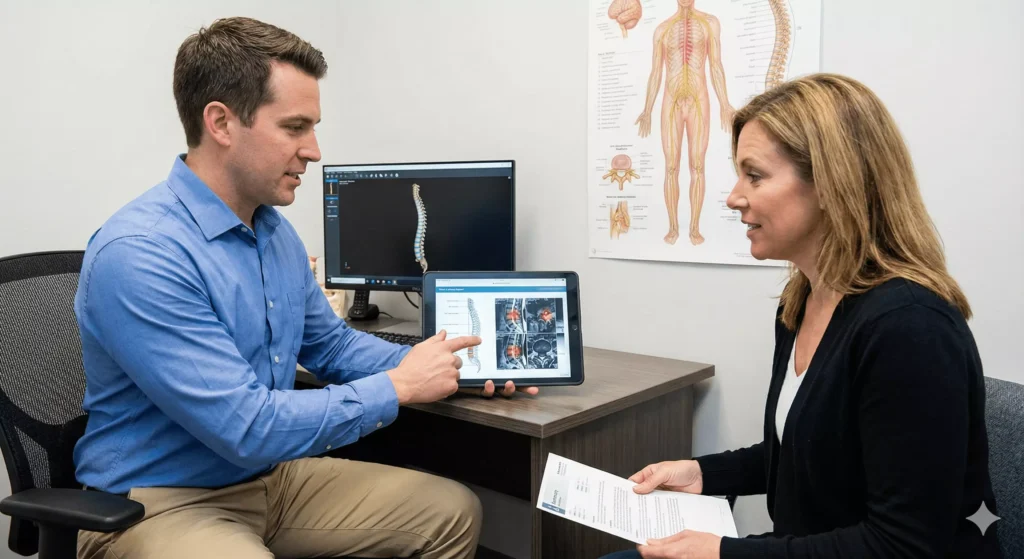
After your examination, your chiropractor will present a structured report of findings — a personalised summary of what was observed during your posture analysis, movement testing, and any neurological or orthopaedic assessments. This clinical report forms the foundation of your chiropractic diagnosis and informs your individualised care strategy.
For deeper detail, see your personalised chiropractic treatment plan.
Understand Your Report of Findings
Your chiropractor will clearly explain the underlying causes of your symptoms. These may include spinal misalignments, joint restrictions, muscle tension, or imbalanced movement patterns. You’ll also learn how lifestyle factors such as poor posture, prolonged sitting, or repetitive strain may be contributing to your condition.
This conversation is detailed and collaborative. Visual tools — such as spine models or posture diagrams — may be used to enhance your understanding of the biomechanical issues at play. You are encouraged to ask questions and share your concerns to ensure you feel fully informed.
Review Your Personalised Treatment Plan
Once your diagnosis is explained, your chiropractor will outline a treatment plan specifically tailored to your condition and recovery goals. This typically includes:
- A series of chiropractic adjustments, mobilisations, or manual therapy techniques
- Lifestyle recommendations such as posture corrections, ergonomic changes, or stretching routines
- A suggested visit frequency and review schedule to monitor progress
The treatment plan is developed in partnership with you. It reflects both clinical findings and your personal preferences, ensuring you are comfortable with each step before proceeding.
For more details, see the progress reviews and maintenance options.
Optional First Treatment with Informed Consent
In many cases, you may be eligible to begin treatment during your initial visit. If this is appropriate, your chiropractor will explain what the first adjustment or therapy session will involve. You will always have the option to proceed on the day or schedule treatment for a future date — no pressure, no obligation.
Your consent is central to the process. At Freedom Clinics, we respect your autonomy and ensure that every stage of care is guided by clear communication and mutual agreement.
For more information, see step-by-step chiropractic consent.
First Chiropractic Treatment (If Appropriate)
If it is clinically appropriate and you’re comfortable proceeding, your chiropractor may offer your first chiropractic treatment during the same visit. This step is based on diagnostic findings, your health status, and — most importantly — your informed consent. You are always in control of when treatment begins.
For more details, see the safety and risk considerations.
What to Expect During Your First Chiropractic Adjustment
The initial treatment typically involves a chiropractic adjustment — a precise, manual technique designed to restore spinal alignment, improve joint mobility, and reduce nerve irritation. These adjustments are tailored to your diagnosis and physical needs.
Depending on your presentation, your chiropractor may also incorporate:
- Soft tissue therapy to relieve muscular tension
- Joint mobilisation to improve restricted movement
- Stretching techniques to support postural correction
Every technique is explained bevforehand. If you prefer to wait before beginning treatment, that option is always respected. No chiropractic procedure is performed without your full understanding and agreement.
For further information, see what we do for shoulder pain during adjustments.

Consent and Comfort Come First
Informed consent is a cornerstone of care at Freedom Clinics. Your chiropractor will discuss the proposed treatment, answer any questions, and ensure you feel safe and supported. If you choose to proceed, treatment is initiated with sensitivity and clinical precision. If you prefer to start on a later date, we’ll schedule your next appointment accordingly.
Your comfort, safety, and autonomy are prioritised throughout every step of your chiropractic care journey.
The UK General Medical Council’s ‘Decision making and consent’ guidance states that shared decision-making and informed consent are fundamental to good medical practice; this supports Freedom Clinic’s policy of discussing options, risks, benefits, and patient preferences before any procedure.
How You Might Feel After Your First Treatment
Following your first adjustment or therapy session, it’s normal to experience one or more of the following:
- Mild soreness or tightness, similar to post-workout fatigue
- Noticeable relief or increased flexibility
- Temporary changes in posture awareness or mobility
Your chiropractor will provide aftercare guidance — such as light movement, hydration, and activity modifications — to help your body integrate the treatment effectively.
A 2010 systematic review from the Universities of Warwick and Oxford reported that minor, transient reactions—such as local soreness and stiffness—are common after manual therapy, while serious adverse events are rare; this supports advising patients that short-lived post-treatment soreness can occur.
At Freedom Clinics, our goal is to ensure that your first chiropractic experience is not only effective but empowering. Your initial treatment is just the beginning of a care journey focused on restoring balance, relieving discomfort, and helping you move forward with confidence.
Next Steps & Your Follow-Up Plan
Your first chiropractic visit is just the beginning of a structured, progressive care journey. To maintain the benefits of your initial treatment and support your long-term recovery, your chiropractor will outline the next steps in your personalised care plan.
Booking Your Follow-Up Appointment
Before you leave the clinic, your chiropractor will schedule a follow-up appointment aligned with your treatment goals. These follow-up visits are essential for:
- Reinforcing spinal adjustments and therapeutic gains
- Monitoring your response to care
- Making timely adjustments to your treatment plan as your condition evolves
Depending on your symptoms and lifestyle demands, your chiropractor may recommend more frequent visits at the start, followed by a tapered schedule as improvements are seen.
Your Ongoing Treatment Plan
Chiropractic care is a dynamic process. At each follow-up appointment, your chiropractor will reassess your posture, movement patterns, and symptom response to determine:
- Whether current treatment methods remain effective
- If any new interventions should be introduced (e.g. corrective exercises, ergonomic advice)
- When to transition to maintenance or preventative care
Your treatment plan evolves alongside your recovery. This approach ensures each session delivers maximum benefit and stays aligned with your individual health goals.
Supporting Your Recovery Between Visits
Patient engagement plays a vital role in chiropractic outcomes. Your chiropractor will provide actionable guidance to support your recovery outside the clinic, including:
- Postural adjustments and movement habits for work, rest, and activity
- Daily mobility and flexibility routines
- Advice on hydration, sleep, and stress management to promote healing
By staying proactive between sessions, you can accelerate progress and extend the benefits of each treatment.
Ongoing Support from Freedom Clinics
Should you have questions or concerns between visits, the Freedom Clinics team is here to help. Our chiropractors and support staff are committed to providing responsive care, informed advice, and a consistent, patient-centred experience.
We don’t just offer treatment — we offer partnership. Every step of your chiropractic journey is guided by expertise, tailored to your needs, and supported by a team that prioritises your well-being.
For any further questions, contact the Chiropractic team.
Reviewed by Tanesa Mohan

Our Chiropractors


References
- National Institute for Health and Care Excellence. (2020). Low back pain and sciatica in over 16s: Assessment and management (NG59) — Recommendations. https://www.nice.org.uk/guidance/ng59/chapter/Recommendations
- Carnes, D., Mars, T. S., Mullinger, B., Froud, R., & Underwood, M. (2010). Adverse events and manual therapy: A systematic review. Manual Therapy, 15(4), 355–363. https://wrap.warwick.ac.uk/id/eprint/37499/
- General Medical Council. (2024, updated from 2020). Decision making and consent. https://www.gmc-uk.org/professional-standards/the-professional-standards/decision-making-and-consent

