
What Is the Jack Test?
The Jack Test—sometimes referred to as Jack’s Test or the Hubscher Manoeuvre—is a key podiatric diagnostic procedure used to evaluate the biomechanical function of the foot arch. It is most commonly employed to diagnose flexible flatfoot (pes planus) by observing how the medial longitudinal arch responds during hallux dorsiflexion (the upward bending of the big toe).
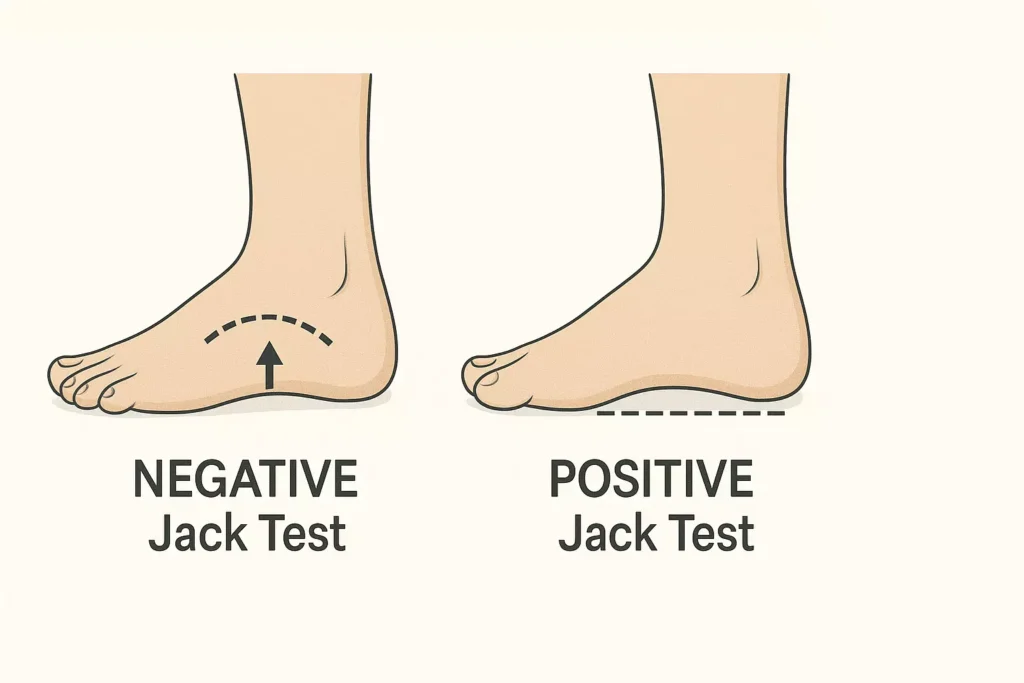
When the arch rises appropriately during the test, it indicates a functional windlass mechanism and normal foot biomechanics. If the arch fails to elevate, this suggests a breakdown in the plantar fascia’s tensioning system, pointing towards a positive Jack Test result and a likely diagnosis of flexible flatfoot.
Medically reviewed by: Dr Priya Anand DPM. Last update: 18th May 2026
Book your appointment
Why Is the Jack Test Important in Podiatry?
Within clinical podiatry, the Jack Test is valued because it:
- Provides a quick, non-invasive assessment of arch stability.
- Helps differentiate between rigid flatfoot and flexible flatfoot.
- Identifies early signs of arch instability that may contribute to gait abnormalities.
- Guides decisions on orthotic prescription, rehabilitation, and further gait analysis.
This makes it one of the most widely applied tools in foot biomechanics, often used alongside other diagnostic methods to build a complete picture of foot posture and function.
Historical Background of the Jack Test
The test was first formally described in the 1950s by Ewen A. Jack, giving it the name by which it is still known today. Over the decades, the Jack Test has become a foundational biomechanical assessment, not just for podiatrists but also for physiotherapists and orthopaedic specialists interested in foot posture and lower-limb mechanics.
Its enduring clinical value lies in its simplicity: with no special equipment required, the Jack Test can be performed in almost any setting, making it ideal for initial flatfoot screening in both adults and children.
Anatomical Concepts Behind the Jack Test
A proper understanding of the Jack Test requires examining the biomechanical chain responsible for maintaining foot arch integrity—particularly the role of the windlass mechanism, plantar fascia, hallux dorsiflexion, and the midtarsal joint complex. These structures collectively determine whether the medial longitudinal arch elevates as expected, which is the observable outcome used to determine a positive or negative Jack Test result.
The Windlass Mechanism and Arch Elevation
The windlass mechanism is a key component of normal foot biomechanics, describing how toe dorsiflexion creates tension in the plantar fascia, pulling the heel and forefoot closer together and lifting the medial longitudinal arch.
During the Jack Test, when the hallux (big toe) is dorsiflexed, this mechanism should automatically raise the arch. If the arch remains flat, it signals that the windlass mechanism is not engaging correctly—a hallmark of flexible flatfoot (pes planus). This makes the windlass mechanism not just anatomical, but directly diagnostic.
Plantar Fascia Function and Diagnostic Significance
The plantar fascia is a fibrous tissue band running from the calcaneus (heel bone) to the base of the toes. Its role is to maintain passive tension across the foot’s medial arch, particularly during gait propulsion.
In a healthy foot, the tensioning of the plantar fascia during hallux dorsiflexion (as in the Jack Test) should elevate the arch. However, if the fascia is overstretched, weakened, or inflamed—such as in plantar fasciitis or posterior tibial tendon dysfunction—the mechanism fails, and the arch collapses. This dysfunction produces a positive Jack Test, reinforcing its role as a quick and cost-effective screen for biomechanical collapse.
Midtarsal Joint Mechanics in Foot Stability
The midtarsal joint complex—consisting primarily of the talonavicular and calcaneocuboid joints—acts as a mechanical lock. During hallux dorsiflexion, it must transition from a flexible to a rigid lever to allow efficient foot stabilisation.
In patients with joint laxity, hyperpronation, or ligamentous insufficiency, this locking mechanism fails, resulting in ongoing midfoot flexibility. Even if the plantar fascia is intact, a non-locking midtarsal joint can still cause a positive Jack Test due to delayed or absent arch elevation. This is particularly important in pediatric flexible flatfoot or adult-acquired flatfoot syndrome.
Biomechanical Chain Failures and Diagnostic Outcomes
A positive Jack Test suggests failure at one or more of the following anatomical checkpoints:
- Weak or overstretched plantar fascia
- Dysfunctional or hypermobile midtarsal joint
- Limited or compensatory hallux dorsiflexion
Understanding which link in this biomechanical chain is dysfunctional allows podiatrists to tailor interventions such as custom orthotics, stabilisation exercises, or gait retraining protocols.

Step-by-Step: How the Jack Test Is Performed
The Jack Test is a manual diagnostic manoeuvre used in podiatry to assess the functional response of the medial longitudinal arch during dorsiflexion of the hallux, thereby probing the integrity of the arch-support mechanism.
According to the foot-and-ankle clinicians at the American Physical Therapy Association’s Sports Section, this test evaluates the windlass mechanism by dorsiflexing the hallux while weight-bearing and watching for arch elevation. (ACE Physical Therapy and Sports Medicine Institute describes how dorsiflexion of the toes engages the plantar fascia to elevate the arch). It evaluates the activation of the windlass mechanism, offering insight into the biomechanical integrity of the foot’s arch-support system. Here’s how the test is accurately performed:
Jack Test Procedure (Weight-Bearing Method)
1. Patient Positioning:
Ask the patient to stand in a neutral, weight-bearing posture. This places natural load on the foot arch, replicating real-life gait conditions necessary for assessing flexible flatfoot.
2. Passive Hallux Dorsiflexion:
Using your hand, gently dorsiflex the hallux (lift the big toe upward) without causing discomfort. This movement should engage the windlass mechanism, creating passive tension in the plantar fascia.
3. Observe Arch Behavior:
Closely monitor the medial longitudinal arch:
- If the arch elevates, the test is negative, indicating functional biomechanics.
- If the arch remains collapsed, the test is positive, suggesting dysfunction in the windlass mechanism or arch-support structures—hallmarks of flexible pes planus.

Testing Variations and Clinical Modifications
While the weight-bearing Jack Test is standard, several modifications exist:
Non-Weight-Bearing Jack Test
Performed with the patient seated or supine, this variation can be useful when weight-bearing is not possible. However, without plantar loading, the test may underestimate pathology, leading to false negatives in early-stage flatfoot or posterior tibial tendon dysfunction.
Active vs Passive Dorsiflexion
Some clinicians assess active hallux dorsiflexion, where the patient lifts their own toe. Yet passive dorsiflexion—performed by the clinician—offers greater consistency for detecting arch elevation failure linked to windlass mechanism breakdown.
Clinical Observations and Diagnostic Indicators
| Observation | Interpretation |
|---|---|
| Arch elevates during toe lift | Windlass mechanism intact → Negative Jack Test |
| Arch remains collapsed | Windlass mechanism failure → Positive Jack Test, likely flexible flatfoot |
| Limited toe motion | Possible hallux limitus or forefoot restriction |
| Pain during dorsiflexion | May indicate plantar fascia strain, joint capsule involvement, or hyperpronation stress |
Clinical Note
A positive Jack Test reflects an inability of the windlass mechanism to properly elevate the foot arch. This finding is often seen in cases of functional flatfoot, plantar fasciitis, and midfoot hypermobility. As part of a comprehensive biomechanical evaluation, it may guide referrals for gait analysis, orthotic prescription, or further imaging.
Understanding the Results of the Jack Test
The Jack Test provides critical insights into the function of the foot’s medial longitudinal arch and the integrity of the windlass mechanism. By evaluating how the arch responds to hallux dorsiflexion, clinicians can assess biomechanical competency, differentiate between flexible and rigid flatfoot, and determine the presence of functional dysfunction within the plantar fascia or midtarsal joint complex.
What Does a Negative Jack Test Mean?
A negative Jack Test is observed when passive dorsiflexion of the hallux produces a clear elevation of the medial longitudinal arch. This indicates:
- Full engagement of the windlass mechanism
- Effective plantar fascia tension
- Locked or semi-rigid midtarsal joint mechanics
- No significant structural collapse under load
This result suggests a biomechanically functional foot, with no clinical evidence of flexible pes planus or arch collapse. In most cases, no intervention is required beyond monitoring.
What Does a Positive Jack Test Indicate?
A positive Jack Test occurs when hallux dorsiflexion fails to elevate the arch, suggesting a breakdown in the biomechanical chain supporting the foot’s structure. This typically reflects:
- Dysfunction or elongation of the plantar fascia
- Failure of the windlass mechanism to activate
- Excessive flexibility or hypermobility in the midtarsal joint
- Visual flattening of the medial arch under weight-bearing
This pattern strongly correlates with flexible flatfoot, especially in pediatric cases or early-stage adult-acquired flatfoot syndrome. The arch may appear on non-weight-bearing inspection but collapses under load.
Flexible vs Rigid Flatfoot: Diagnostic Comparison
Correct interpretation of the Jack Test involves distinguishing between flexible and rigid flatfoot—two clinically distinct conditions with different treatment paths.
| Feature | Flexible Flatfoot | Rigid Flatfoot |
|---|---|---|
| Jack Test | Positive (no arch rise) | Negative (arch fixed in collapse) |
| Arch in non-weight-bearing | Present | Absent |
| Joint mobility | Excessive | Limited or fixed |
| Pain onset | Often later | Typically early |
| Treatment | Orthotics, therapy | May require surgical evaluation |
This differential diagnosis allows practitioners to tailor treatment plans according to the structural flexibility and functional capacity of the foot.
Diagnostic Nuances: Can the Jack Test Be Wrong?
While the Jack Test is a trusted biomechanical assessment tool, certain factors may influence its accuracy:
- False Positives may arise in hypermobile patients or due to poor positioning during testing.
- False Negatives can occur when fascia engagement masks early dysfunction.
- Conditions such as hallux limitus, posterior tibial tendon dysfunction, or ankle equinus can obscure results.
Therefore, results should be interpreted alongside:
- Gait analysis
- Subtalar joint assessment
- Patient-reported symptoms
- Weight-bearing radiographs (if necessary)
What Happens After a Positive Jack Test?
A positive Jack Test often signals the need for further clinical evaluation. Depending on symptoms and co-diagnoses, next steps may include:
- Prescription of custom foot orthotics to support the arch
- Referral for advanced imaging (e.g., MRI, X-ray)
- Enrollment in a gait rehabilitation program
- Monitoring for progressive flatfoot deformity
This helps prevent chronic overuse injuries, plantar fascial strain, and long-term gait impairment.
For a broader explanation of causes, symptoms, and treatment, see our flexible flat feet overview.
Jack Test in the Context of Podiatric Diagnostics
The Jack Test is a foundational tool in the biomechanical assessment of the foot, particularly for diagnosing functional flatfoot. Its true diagnostic value emerges when interpreted alongside other podiatric evaluations. In this section, we examine how the Jack Test integrates into broader clinical workflows, interacts with complementary procedures, and guides clinical decisions.
Where the Jack Test Fits in Podiatric Assessment
Typically performed early in a biomechanical exam, the Jack Test helps identify windlass mechanism dysfunction and arch instability. However, it’s most informative when used in conjunction with:
- Gait Analysis
Evaluates dynamic foot function during ambulation, detecting compensations, overpronation, and propulsion issues missed in static testing. - Tip-Toe (Heel Raise) Test
Assesses posterior tibial tendon function—particularly useful when the Jack Test is positive and adult-acquired flatfoot is suspected. - Subtalar Joint Range of Motion
Limited motion can obscure the Jack Test result, falsely suggesting rigidity in otherwise flexible flatfoot cases. - Silfverskiöld Test
Identifies gastrocnemius-soleus tightness, a contributing factor in midfoot instability, arch collapse, and altered Jack Test findings.
Comparing the Jack Test with Other Diagnostic Tools
| Diagnostic Tool | Purpose | Relation to Jack Test |
|---|---|---|
| Jack Test | Evaluates windlass mechanism activation via passive dorsiflexion | Primary screen for flexible flatfoot |
| Heel Raise Test | Tests posterior tibial tendon strength and arch restoration | Often used in tandem with Jack Test for PTTD |
| Gait Analysis | Assesses foot mechanics in real motion | Confirms dysfunction observed during Jack Test |
| Weight-Bearing X-Ray | Visualises bony alignment and arch angles | Follows up positive Jack Test with structural confirmation |
| MRI / Ultrasound | Evaluates soft tissues (fascia, tendons) | Used when fascia or tendon damage is suspected |
This comparison underscores the Jack Test’s role as a front-line, functional test, with downstream referrals triggered by its findings.
Functional Cluster: What the Jack Test Tells Us
When combined with other assessments, the Jack Test can:
- Flag windlass mechanism failure
- Suggest posterior tibial tendon involvement
- Indicate need for orthotic prescription
- Justify referral for imaging (if deformity suspected)
- Provide early warning of progressive flatfoot disorders
“A positive Jack Test followed by heel raise weakness strongly suggests Stage II adult-acquired flatfoot, where tendon insufficiency drives midfoot collapse.”
When to Escalate After a Jack Test
A positive Jack Test becomes a diagnostic inflection point, especially when corroborated by:
- Difficulty in single-leg heel raise
- Subtalar joint instability
- Arch collapse visible on gait observation
- Patient-reported foot fatigue or medial pain
In these cases, escalation to advanced diagnostics or treatment planning may include:
- Custom orthotics
- Targeted physical therapy
- Weight-bearing imaging
- Referral to an orthopaedic specialist
For further comparison with other assessments, explore our podiatric diagnostics hub.
Clinical Use Cases and Patient Scenarios for the Jack Test
The Jack Test serves as a versatile biomechanical diagnostic tool, applied across various patient demographics—from pediatric evaluations to complex adult-acquired pathologies. This section presents real-world case scenarios where the test influences diagnosis, guides intervention, or supports treatment validation.
Pediatric Flexible Flatfoot: Functional vs Structural
Can the Jack Test diagnose flat feet in children?
In children, especially under age 10, flexible flatfoot is often a benign developmental variation. The Jack Test helps differentiate between:
- Functional flatfoot, where the arch reconstitutes on dorsiflexion, indicating no intervention needed.
- Structural or pathological flatfoot, where no arch elevation occurs, suggesting ligamentous laxity or a developing deformity.
Adult-Acquired Flatfoot (Stage I–II)
Is the Jack Test reliable in adult-acquired flatfoot syndrome (AAFS)?
Yes. In Stage I or early Stage II AAFS, a positive Jack Test—combined with heel raise failure—often indicates posterior tibial tendon dysfunction (PTTD).
Gait Instability in Hypermobile Adults
Does hypermobility affect Jack Test outcomes?
Absolutely. In patients with systemic laxity (e.g. Ehlers-Danlos syndrome), the Jack Test helps distinguish functional instability from structural deformity.
Monitoring Plantar Fascia Recovery
Can the Jack Test evaluate plantar fascia function post-treatment?
Yes. It can confirm windlass mechanism reactivation following rehabilitation for plantar fasciitis.
Diagnostic Pathway Triggers
When should the Jack Test lead to further evaluation?
Positive results—especially with pain, gait changes, or arch rigidity—can trigger:
- Weight-bearing X-rays to confirm osseous deformity
- MRI or ultrasound to evaluate the posterior tibial tendon or plantar fascia
- Referral to rheumatology for systemic hypermobility assessment
- Podiatric surgical evaluation if rigid flatfoot is suspected
The test acts as a clinical gateway, guiding decision-making and multidisciplinary referrals.
Learn more about staging, symptoms, and management in our posterior tibial tendon dysfunction guide.
Treatment Implications Based on Jack Test Results
The outcome of the Jack Test serves as a critical clinical indicator, determining whether conservative treatment, ongoing monitoring, or referral to specialist care is warranted. Whether assessing flexible flatfoot, posterior tibial tendon dysfunction (PTTD), or plantar fascia insufficiency, the test helps stratify patients based on biomechanical dysfunction.
Negative Jack Test: Biomechanically Functional Foot
A negative Jack Test—where hallux dorsiflexion results in medial arch elevation—indicates that the windlass mechanism and plantar fascia are functioning properly. This typically corresponds to:
- No evidence of flexible flatfoot or tendon dysfunction
- Stable subtalar and midfoot joints
- Adequate arch support under load
Management Strategy:
- No treatment required in asymptomatic individuals
- Footwear education for proper arch support
- Preventative orthotics in hypermobile or at-risk populations
- Pediatric monitoring if developmental flatfoot is present but functionally intact
Positive Jack Test: Functional Instability Requires Intervention
A positive Jack Test, where the arch fails to rise, reveals windlass mechanism dysfunction, most commonly seen in:
- Flexible flatfoot / pes planus
- Plantar fascia laxity or overload
- Posterior tibial tendon dysfunction (Stage I–II)
- Hyperpronation or gait instability
First-Line Interventions
| Treatment | Purpose | Entity Alignment |
|---|---|---|
| Custom Orthotics | Supports the medial longitudinal arch, improves gait alignment | Orthotics + Flatfoot |
| Plantar Fascia Loading Protocols | Stimulates fascia engagement, reactivates windlass | Plantar Fascia + Windlass |
| Gait Retraining | Reduces overpronation and dynamic instability | Gait + Flatfoot |
| Motion-Control Footwear | Stabilises the rearfoot, limits excessive motion | Flatfoot + Orthotics |
| Posterior Tibial Tendon Strengthening | Addresses tendon insufficiency, delays progression | PTTD + Collapse |
“The Jack Test becomes a functional entry point to individualised care. A positive result prompts multi-factorial rehabilitation planning.”
Persistent Positive Jack Test: Escalation Criteria
If the Jack Test remains persistently positive after 6–12 weeks of structured conservative treatment—or if structural progression is suspected—escalation is advised:
Escalation Pathways
- Weight-Bearing Imaging to assess osseous alignment and arch height
- MRI / Ultrasound for detailed evaluation of posterior tibial tendon and plantar fascia integrity
- Rheumatology Referral if systemic hypermobility is suspected
- Podiatric Surgical Consultation for fixed deformities or Stage III–IV flatfoot
Using the Jack Test to Monitor Treatment Progress
The Jack Test can serve as a functional progress marker during rehabilitation. A shift from positive to negative indicates:
- Improved plantar fascia tensioning
- Reactivation of the windlass mechanism
- Successful orthotic integration
- Stabilisation of gait dynamics
Re-testing every 4–6 weeks offers a low-cost, non-invasive check on treatment efficacy and recovery trajectory.
Clinical Flow Summary Table
| Jack Test Result | Interpretation | Primary Action |
|---|---|---|
| Negative | Functional foot with no arch collapse | Monitor or educate |
| Positive (Initial) | Flexible flatfoot, fascia dysfunction, PTTD | Begin conservative treatment |
| Positive (Persistent) | Progressive or rigid pathology | Imaging, referral, escalation |

For assessment steps, footwear changes, and prescription devices, see our custom orthotics treatments.
Limitations, Controversies, and Complementary Testing in Jack Test Use
Despite its clinical utility, the Jack Test is not without limitations. As a functional screen for flatfoot and windlass mechanism integrity, its reliability varies across patient types, examiner skill levels, and associated conditions. To ensure diagnostic precision, clinicians must recognise its constraints and augment findings with complementary tests.
Core Limitations of the Jack Test
1. Examiner Subjectivity and Technique Variability
Minor inconsistencies in hallux dorsiflexion angle, patient positioning, or applied force can impact the result—producing false negatives or positives.
2. Subtalar Joint Stiffness or Fusion
A stiff or arthritic subtalar joint can restrict midfoot motion, rendering the Jack Test falsely negative in the presence of structural flatfoot.
Example: A patient with subtalar coalition may demonstrate no arch rise despite having flexible ligament structures elsewhere.
3. Pediatric Population and Developmental Flatfoot
In children under age 10, physiological flatfoot is common. A positive Jack Test alone should not drive intervention unless it coexists with abnormal gait, pain, or ligamentous laxity.
4. Confounding Factors: Obesity, Hypermobility, and Neuromuscular Delay
In hypermobile individuals or those with increased adiposity, arch response may be delayed or dampened, leading to ambiguous interpretations.
Diagnostic Ambiguity & Clinical Controversies
- False Positives in Hypermobility Syndromes
Patients with Ehlers-Danlos or generalised ligament laxity may show positive Jack Test findings without pathological flatfoot, complicating interpretation. - Lack of Specificity in Multimorbid Patients
Comorbidities like diabetes or inflammatory arthritis may alter soft tissue tone, reducing diagnostic clarity. - Over-Reliance on Single Assessment
The Jack Test should not be used in isolation; it must be integrated into a multi-factorial biomechanical evaluation.
Complementary Tests to Improve Diagnostic Confidence
| Test | Purpose | Entity Relationship |
|---|---|---|
| Heel Raise Test | Evaluates posterior tibial tendon function | Jack Test + PTTD |
| Navicular Drop Test | Quantifies medial arch collapse in weight-bearing | Jack Test + Flatfoot |
| Silfverskiöld Test | Assesses gastroc-soleus tightness, a contributor to midfoot dysfunction | Windlass + Calf tension |
| Gait Analysis | Visualises dynamic foot function during stance and propulsion | Jack Test + Gait Dysfunction |
| Weight-Bearing Radiographs | Objectively assesses bone alignment and arch height | Structural confirmation tool |
“When a positive Jack Test is combined with a failed heel raise test, the likelihood of posterior tibial tendon dysfunction (PTTD) increases significantly.”
Diagnostic workflow and instruments are covered in our gait biomechanics assessment.

Our Podiatrists & Chiropodists


References
- ACE Physical Therapy and Sports Medicine Institute. (n.d.). Windlass mechanism of the foot. https://ace-pt.org/ace-physical-therapy-and-sports-medicine-institute-windlass-mechanism-of-the-foot/

