
Why Gait Matters
Gait—the way you move when walking or running—is more than just a motion; it’s a biomechanical blueprint of your body’s efficiency, stability, and potential risk for injury. Small gait differences between walking and running can create significant impacts on your foot posture, joint alignment, and overall musculoskeletal health.
At Freedom Clinics, our podiatry team specialises in diagnosing abnormal gait patterns using advanced gait analysis systems. Whether you’re a seasoned runner, a casual walker, or recovering from injury, understanding your walking and running gait mechanics is essential to preventing pain and optimising performance.
“Correct gait is not about perfection—it’s about balance, posture, and biomechanics. Every step tells a story.”
Through this educational guide, you’ll discover:
- The critical biomechanical phases of gait
- Key distinctions between walking gait and running gait
- How faulty gait contributes to conditions like plantar fasciitis, shin splints, and knee pain
- How Freedom Clinics’ gait analysis informs the design of custom orthotics and movement therapies
Medically reviewed by: Dr Priya Anand DPM. Last update: 18th May 2026
Book your appointment
Understanding the Gait Cycle
The gait cycle is the full sequence of movements made by the lower limbs during a complete stride—starting from the moment one foot contacts the ground to the moment it contacts the ground again. This biomechanical sequence is essential for efficient locomotion, whether walking or running, and provides valuable insight into joint health, muscle function, and postural alignment.
A. Phases of the Gait Cycle
The gait cycle is composed of two primary phases that occur in both walking gait and running gait:
- Stance Phase: This is the portion of the gait where the foot is in contact with the ground, bearing weight and stabilising movement.
- Swing Phase: Occurs when the foot leaves the ground and swings forward to prepare for the next step.
According to research from the European Society of Physical and Rehabilitation Medicine, approximately 60% of the gait cycle during normal walking is spent in the stance phase. In running gait, however, the stance phase shortens considerably and is interrupted by a flight phase—a brief moment when both feet are off the ground entirely. This fundamental biomechanical distinction underpins the increased impact force and muscle recruitment associated with running.

B. Key Biomechanical Components of Gait
Understanding the biomechanical variables of gait helps clinicians and patients recognise patterns that could indicate risk or inefficiency:
- Cadence: The number of steps taken per minute. Cadence is typically lower in walking and higher in running, affecting joint stress and energy output.
- Stride Length: The distance between successive foot strikes of the same foot—longer in runners, shorter in walkers.
- Foot Contact Pattern: Most walkers exhibit a heel strike pattern, while runners often transition to midfoot or forefoot strike, altering load distribution.
- Ground Reaction Forces: The intensity of force experienced by the foot upon ground contact. Running can generate forces up to 3x body weight.
- Joint Loading: Each gait style influences load through the hips, knees, and ankles differently, impacting injury susceptibility.
“Every gait pattern contains biomechanical signatures that reveal how your body functions in motion. Identifying these nuances helps us prevent injuries and prescribe targeted treatments.”
Clinical Application at Freedom Clinics
At Freedom Clinics, we use pressure-sensitive gait analysis platforms and 3D motion capture systems to evaluate your individual gait cycle. Our podiatrists analyse your stance and swing phases, assess foot strike mechanics, and measure cadence and stride symmetry. This comprehensive evaluation guides our design of custom orthotics and rehabilitation plans for improved movement and long-term foot health.
Walking Gait Mechanics
The walking gait is a highly structured and energy-efficient form of locomotion characterised by a consistent heel-to-toe movement pattern and continuous foot-ground contact. This distinguishes it from running and plays a central role in maintaining postural stability, joint alignment, and long-term foot health.
A. Key Phases of Walking Gait
The walking gait cycle consists of three distinct biomechanical phases, each with a critical function:
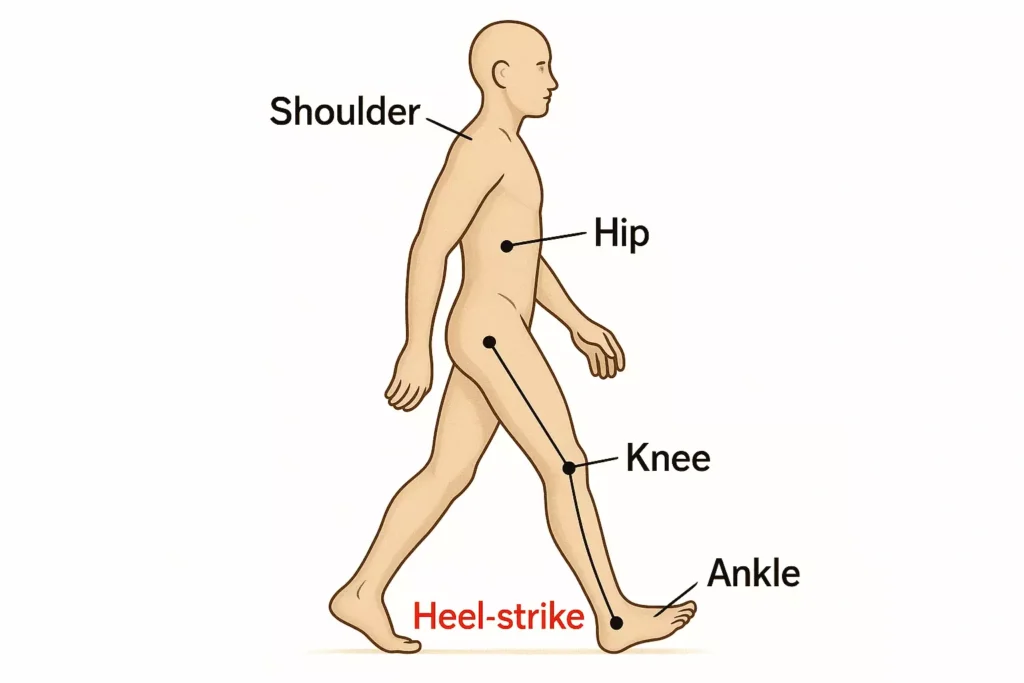
- Heel Strike: The gait cycle begins when the heel makes contact with the ground, initiating the stance phase. This phase absorbs shock and sets up body alignment for controlled motion.
- Midstance: Body weight shifts over the stationary foot. Stability and balance are dependent on correct ankle alignment, foot posture, and core activation.
- Toe-Off: The foot pushes off the ground using the forefoot and toes, transitioning into the swing phase. This action propels the opposite leg forward and sustains stride rhythm.
Throughout walking, at least one foot remains in contact with the ground, minimising vertical oscillation and reducing ground reaction force.
B. Muscle Activation During the Walking Gait Cycle
Proper muscle engagement ensures that walking is smooth, stable, and mechanically sound. Each phase of walking gait involves distinct muscle groups:
- Tibialis Anterior: Controls dorsiflexion during heel strike, preventing foot slap.
- Gastrocnemius and Soleus (Calves): Assist in midstance stability and forward propulsion at toe-off.
- Gluteus Medius and Hamstrings: Regulate pelvic control and leg swing efficiency.
When these muscles are underactive or imbalanced, compensatory movements can develop, increasing risk of fatigue and joint stress.
C. Common Deviations in Walking Gait
Many people experience altered gait patterns due to anatomical variation, past injuries, or habitual movement errors. Common walking gait deviations include:
- Overpronation: The foot excessively rolls inward post-heel strike, linked to flat arches and medial ankle strain.
- Supination (Underpronation): The foot fails to roll inward adequately, stressing the lateral foot and reducing shock absorption.
- Shortened Stride Length: Often seen in older adults or those compensating for pain or joint stiffness.
- Hip Drop: Indicates gluteal weakness and poor pelvic stabilisation during midstance.
“Each of these walking gait deviations can contribute to chronic discomfort, reduced efficiency, and a greater risk of lower limb injury if left uncorrected.”
Clinical Insight from Freedom Clinics
At Freedom Clinics, our podiatrists conduct detailed walking gait assessments using real-time motion capture, pressure plate systems, and muscle function diagnostics. This allows us to detect even subtle gait abnormalities, design custom insoles, and deliver individualised therapy protocols aimed at correcting dysfunctional patterns and preventing recurring injuries.
Running Gait Mechanics
According to a review published in Frontiers in Bioengineering and Biotechnology, the running gait includes a flight phase where neither foot contacts the ground and generates vertical ground reaction forces up to three times body weight. It places increased demands on the muscular system, joints, and connective tissues, often making it a source of overuse injuries when biomechanical form is compromised.
Unique Characteristics of Running Gait
Unlike walking, running introduces a flight phase—a moment where neither foot is in contact with the ground. This airborne interval increases impact stress and necessitates heightened neuromuscular control.
Other defining features of the running gait include:
- Reduced Stance Time: The foot spends less time on the ground, increasing the need for efficient shock absorption.
- Foot Strike Variability: Runners typically engage in either a forefoot, midfoot, or heel strike, each of which affects joint loading and propulsion mechanics.
- Increased Stride Frequency: Running generally involves a higher cadence, which modifies impact distribution and muscle activation patterns.
“The flight phase is what makes the running gait cycle uniquely demanding—and potentially injury-inducing—without proper alignment and technique.”
Muscle Activation in Running
Running involves a powerful, coordinated sequence of muscle engagement to manage both vertical lift and forward propulsion:
- Gluteus Maximus: Drives hip extension during stance and enhances propulsion.
- Quadriceps: Absorb ground impact and provide knee stabilisation during landing.
- Calves (Gastrocnemius & Soleus): Assist with foot control and generate toe-off power.
- Hamstrings: Modulate knee flexion during swing and control hip alignment.
When these muscles underperform, the body compensates—often leading to excessive joint strain, inefficiency, and eventual injury.
Common Running Gait Faults
Our clinicians at Freedom Clinics regularly diagnose maladaptive gait patterns that increase injury risk:
- Overstriding: Landing with the foot far ahead of the body’s center of mass, amplifying braking forces and increasing the risk of shin splints and knee injuries.
- Heel Striking at Speed: Common among novice runners, this strike pattern intensifies joint loading and reduces propulsion efficiency.
- Pelvic Drop or Hip Hike: Indicates gluteal weakness or asymmetry in pelvic stabilisation.
- Trunk Rotation or Arm Asymmetry: Can signify compensatory mechanisms stemming from lower-limb imbalances or poor core control.
“Many injuries associated with running stem from inefficiencies in the gait cycle, not isolated incidents. Identifying these inefficiencies is critical for recovery and prevention.”
Diagnostic & Treatment Approach at Freedom Clinics
Using 3D gait analysis, pressure-sensitive platforms, and kinematic modeling, our team evaluates:
- Foot strike pattern
- Stance duration
- Muscle recruitment timing
- Ground reaction force levels
Based on this assessment, we provide:
- Performance-specific orthotics
- Cadence retraining programs
- Targeted strength and rehabilitation plans

Walking vs Running: A Comparative Analysis
Although walking gait and running gait share the foundational phases of the gait cycle, they differ substantially in terms of biomechanical loading, neuromuscular activation, and clinical implications. Understanding these differences is essential for identifying the root causes of movement-related injuries and tailoring effective treatment interventions.
Biomechanical Differences Between Walking and Running Gait
| Biomechanical Feature | Walking Gait | Running Gait |
|---|---|---|
| Foot Strike Pattern | Predominantly heel strike | Forefoot, midfoot, or heel strike, depending on speed and form |
| Ground Contact | Continuous—at least one foot on the ground at all times | Includes a flight phase—both feet leave the ground momentarily |
| Stride Length | Shorter, energy-conserving | Longer, momentum-driven |
| Cadence | Typically 100–120 steps per minute | Typically 160–180 steps per minute |
| Ground Reaction Force | Lower, evenly distributed | Up to 3x body weight at impact |
| Joint Load Distribution | Lower stress on knees and hips | Greater force absorption demands on lower limb joints |
| Energy Efficiency | Maximised for conservation | Optimised for propulsion and speed |
“While walking favours postural control and energy conservation, running prioritises kinetic power and dynamic force generation—both requiring distinct biomechanical strategies.”
Muscle Engagement Variance
- Walking gait emphasises postural muscles like the tibialis anterior and gluteus medius, supporting balance and alignment.
- Running gait engages explosive muscle groups including the gluteus maximus, hamstrings, and calves, which provide forward propulsion and manage high-impact forces.
These contrasting patterns underscore the need for gait-specific diagnostics when addressing issues like chronic fatigue, foot pain, or movement inefficiencies.
Comparative Injury Risks and Clinical Relevance
Walking Gait Injuries:
- Plantar fasciitis (due to overpronation)
- Hip instability from gluteal weakness
- Midfoot strain linked to poor footwear or stride mechanics
Running Gait Injuries:
- Shin splints from overstriding or rigid heel striking
- Iliotibial band syndrome due to poor lateral hip control
- Runner’s knee and Achilles tendinopathy from high-impact, repetitive loading
At Freedom Clinics, our podiatrists assess whether pain or dysfunction arises from walking or running mechanics, using precision gait analysis to identify:
- Abnormal foot strike patterns
- Imbalances in stride length or cadence
- Joint overload triggers
- Compensatory muscle recruitment

Clinical Impact of Gait Differences
Even subtle gait differences between walking and running can have far-reaching effects on your musculoskeletal system, posture, and joint health. Identifying and understanding these differences is critical for accurate clinical diagnosis, effective treatment planning, and long-term injury prevention.
At Freedom Clinics, our podiatric specialists use precision gait analysis to translate complex biomechanical patterns into actionable diagnostic insights.
Gait Differences as Diagnostic Indicators
Gait abnormalities often reveal the root cause of persistent or recurrent issues such as:
- Foot pain linked to abnormal foot strike patterns
- Knee and hip strain caused by poor stride mechanics
- Lower back discomfort from pelvic misalignment
Research by the University of Florida Department of Physical Medicine and Rehabilitation found that foot overpronation is associated with increased internal tibial rotation and medial knee stress, contributing to knee instability. Heel striking during running can overload the hip and lumbar spine. These movement discrepancies are key diagnostic indicators in clinical gait assessment.
“Each gait pattern carries diagnostic value—if you know how to read it.”
How Gait Analysis Guides Clinical Treatment
At Freedom Clinics, we use advanced tools for biomechanical evaluation, including:
- Pressure plate analysis to examine ground force distribution
- High-speed motion capture to identify timing discrepancies and asymmetries
- Muscle recruitment profiling to detect weaknesses or compensation
From this data, we develop customised clinical pathways:
- Custom orthotics designed to correct gait-specific anomalies
- Movement re-education programs for long-term biomechanical correction
- Targeted strength training and flexibility protocols
- Gait retraining sessions for walking or running optimisation
These interventions directly address both cause and symptom, reducing injury recurrence and improving functional movement efficiency.
Preventive & Performance Benefits
Gait analysis not only supports clinical diagnosis—it also plays a vital role in:
- Preventing repetitive strain injuries
- Enhancing athletic performance by fine-tuning stride cadence and foot mechanics
- Supporting mobility in aging populations by correcting early gait deterioration
Whether you’re managing chronic pain, recovering from injury, or seeking to improve form and efficiency, professional gait assessment offers a data-driven foundation for optimal outcomes.
Your gait isn’t just how you move—it’s how your body expresses efficiency, imbalance, and potential dysfunction. At Freedom Clinics, our diagnostic expertise transforms movement into a measurable, treatable roadmap to better health.

Conclusion & Next Steps: Reclaiming Healthy Movement
Understanding the differences between walking and running gait is more than an academic insight—it’s a gateway to preventing injury, enhancing performance, and maintaining mobility. Whether you’re navigating chronic discomfort or optimising your stride, the clinical interpretation of your gait mechanics is vital.
At Freedom Clinics, our podiatry services specialise in turning movement into medicine. Our expert podiatrists provide detailed gait analysis services tailored to the unique dynamics of walking and running, using industry-leading diagnostic technology and biomechanical expertise.
Why Freedom Clinics?
- Trusted provider of gait assessments in London, specifically serving the Canary Wharf area
- Comprehensive treatment pathways that include:
- Custom orthotics tailored to your gait profile
- Posture correction and strength rehab plans
- Podiatric consultations focused on root-cause resolution
- Integration of podiatry, rehabilitation, and movement science
Ready to Move Smarter? Book Your Gait Assessment Today
Don’t wait for injury to correct your gait. Take proactive steps with a podiatry consultation and precision gait analysis at our Canary Wharf clinic.
Location: Freedom Clinics, Canada Place Shopping Mall, 34 North Colonnade, Canary Wharf, London E14 5HX
Phone: 0203 197 9100
Email: canarywharf@freedomclinics.com
Opening Hours:
Monday–Friday: 7 am–8 pm
Saturday–Sunday: 10 am–4 pm
“Freedom Clinics is where cutting-edge podiatry in London meets personalised care and biomechanical excellence.”
Our Podiatrists & Chiropodists


References
- European Society of Physical and Rehabilitation Medicine. (2022). Present and future of gait assessment in clinical practice. PMCID PMC9800936. https://www.ncbi.nlm.nih.gov/pmc/articles/PMC9800936/
- Nilsson, J., & Thorstensson, A. (1989). Effects of speed on contact time, active peak and impulse in running: A study of ground reaction forces. Frontiers in Bioengineering and Biotechnology, 2(3), Article 1440033. https://www.frontiersin.org/articles/10.3389/fbioe.2024.1440033/full
- Barnes, C., & Brooks, D. (2019). Foot Pronation Contributes to Altered Lower Extremity Loading After Mid‑Distance Running. Frontiers in Physiology, 10, Article 573. https://www.frontiersin.org/articles/10.3389/fphys.2019.00573/full

