
Podiatrist vs Orthopedist: Who to See for Foot, Ankle, and Lower Limb Problems
If you’re experiencing foot pain, ankle discomfort, or ongoing lower limb issues, you might be wondering:
Should I see a podiatrist or an orthopedist?
These two types of specialists often treat overlapping conditions—but their training, scope of practice, and treatment strategies differ in ways that significantly affect your care pathway.
Book your appointment
A podiatrist is a licensed healthcare professional who specialises in the diagnosis, prevention, and treatment of disorders related to the foot, ankle, and lower leg. They commonly manage:
- Plantar fasciitis
- Heel pain
- Bunions
- Flat feet
- Diabetic foot complications
Using tools such as gait analysis, custom orthotics, and minor surgical techniques, podiatrists address the root cause of mobility and alignment issues.
An orthopedist, also referred to as an orthopedic surgeon, is a medical doctor (MD or DO) trained to treat the entire musculoskeletal system. They specialise in:
- Bone fractures of the foot and ankle
- Joint damage or degeneration
- Ligament and tendon injuries
- Foot and ankle deformities requiring surgical intervention
Orthopedists are typically consulted for complex injuries, particularly those requiring surgery, advanced imaging, or multi-joint management.
Choosing the Right Specialist for Your Symptoms
“Do I need a podiatrist or orthopedic surgeon for heel pain, a stress fracture, or gait issues?”
It’s a common question—and the answer depends on your symptoms and goals.
Generally:
- For biomechanical problems and chronic foot pain, start with a podiatrist.
- For traumatic injuries, fractures, or joint surgeries, see an orthopedist.
- Still unsure? Many patients benefit from a combined care approach.
At Freedom Clinics, located in Canary Wharf, London, our experienced podiatrists provide prompt, expert care—without requiring a referral. Whether you’re managing heel pain or want a second opinion before seeing a surgeon, we’re here to guide your next step with confidence.
Understanding Foot and Ankle Specialists
When facing issues with your feet, ankles, or lower limbs, it’s essential to understand the difference between two key medical professionals: the podiatrist and the orthopedist. Both play crucial roles in diagnosing and treating conditions related to mobility, structure, and pain, but their scopes of practice and clinical approaches differ significantly.

What Does a Podiatrist Do?
A podiatrist is a trained medical professional who specialises exclusively in the assessment, diagnosis, and treatment of the foot, ankle, and lower leg. In the UK, podiatrists are registered with the Health and Care Professions Council (HCPC) and play a frontline role in foot and ankle care.
Common services offered by podiatrists include:
- Management of plantar fasciitis, heel pain, and flat feet
- Gait analysis to detect biomechanical misalignment
- Provision of custom orthotics and pressure relief footwear
- Diabetic foot care, including ulcer prevention and wound management
- Minor foot surgeries like bunion shaving or ingrown toenail removal
Podiatrists typically work in private clinics, NHS services, and sports injury centers. At Freedom Clinics, patients can see a podiatrist without a GP referral, gaining rapid access to biomechanical expertise and conservative foot treatment.
Patient Question:
“Is a podiatrist a real doctor in the UK?”
Yes. Podiatrists hold degrees in podiatric medicine and complete extensive clinical training specific to foot and ankle health.
What Does an Orthopedist Do?
An orthopedist or orthopedic surgeon is a medically qualified doctor (MD or DO) who specialises in treating the musculoskeletal system—from head to toe. Their work often overlaps with podiatrists when it comes to the bones, joints, and connective tissues of the lower limbs.
Orthopedists are often involved in:
- Surgical repair of broken bones and torn ligaments in the foot or ankle
- Joint replacements and fusions, especially in cases of arthritis
- Diagnosis of multi-joint problems, such as hip-knee-foot misalignments
- Interpretation of complex scans like MRI, CT, or arthroscopy results
Orthopedists generally work in hospital settings and surgical units. They are best suited for patients with serious trauma, significant structural deformities, or who have failed conservative treatments.
Common Query:
“Should I see an orthopedist for a fractured foot?”
Yes. Orthopedists are the go-to specialists for bone trauma, joint damage, and surgical intervention.
Podiatrist vs Orthopedist: Which Is Best for You?
| Aspect | Podiatrist | Orthopedist |
|---|---|---|
| Area of Specialisation | Foot, ankle, and lower limb | Entire musculoskeletal system |
| Training Path | BSc (Hons) Podiatry or DPM, HCPC-registered | MBBS/MD + surgical residency, GMC-registered |
| Treatment Focus | Biomechanics, skin, nail, orthotic therapy | Surgical intervention, trauma management |
| Conditions Treated | Plantar fasciitis, bunions, diabetic foot | Fractures, ligament tears, arthritis |
| Access Pathway | Direct access at Freedom Clinics | Typically requires GP referral |
Training and Medical Background
Choosing the right healthcare provider often comes down to understanding their qualifications. Both podiatrists and orthopedists undergo rigorous medical training, but their paths—and the focus of their expertise—are distinctly different when it comes to treating foot, ankle, and lower limb conditions.
How Are Podiatrists Trained?
A podiatrist specialises in the foot and ankle from the very beginning of their medical education. In the UK, podiatrists follow a dedicated track that includes:
- Earning a BSc (Hons) in Podiatry or equivalent degree, recognised by the Health and Care Professions Council (HCPC)
- Completing extensive clinical placements focused on biomechanics, gait analysis, foot pathology, and orthotic therapy
- Optionally pursuing postgraduate certifications in podiatric surgery, sports podiatry, or diabetic foot management
Advanced practitioners may qualify to perform surgical procedures, such as:
- Bunion corrections (bunionectomy)
- Toenail surgery (e.g., total or partial nail avulsion)
- Soft tissue repairs and excisions
Podiatrists practicing in clinics like Freedom Clinics are trained to deliver both conservative and interventional care, offering direct access to foot and ankle expertise without a referral.
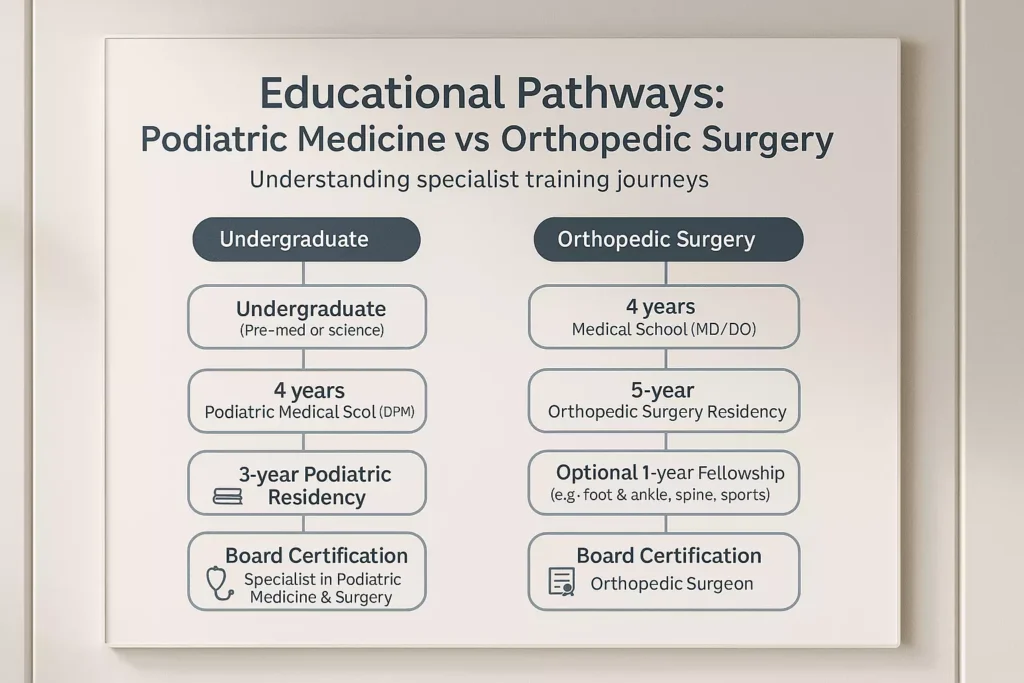
How Are Orthopedists Trained?
An orthopedist or orthopedic surgeon is a medically qualified doctor who specialises in treating the entire musculoskeletal system, including bones, joints, ligaments, and tendons.
Their training pathway typically includes:
- A 5–6 year medical degree (MBBS or MD)
- 2 years of foundation clinical rotations
- 6 years of orthopedic surgical training
- Optional subspecialty fellowship in foot and ankle surgery
Orthopedists are trained to treat conditions requiring:
- Fracture management and fixation
- Joint replacements (e.g., ankle arthroplasty)
- Surgical reconstruction after trauma or deformity
They are registered with the General Medical Council (GMC) and may hold memberships in:
- The British Orthopaedic Association (BOA)
- The Royal College of Surgeons
| Qualification Aspect | Podiatrist | Orthopedist |
|---|---|---|
| Initial Degree | BSc (Hons) Podiatry or DPM | MBBS or MD (Medical Doctor) |
| Area of Specialisation | Foot, ankle, lower limb | Full musculoskeletal system |
| Clinical Focus | Biomechanics, orthotics, foot care | Surgical repair, trauma, joint dysfunction |
| Surgical Training | Optional via Royal College of Podiatry | Integrated surgical residency |
| Certification Body (UK) | HCPC, Royal College of Podiatry | GMC, Royal College of Surgeons, BOA |
Conditions Treated by Each Specialist
When dealing with foot pain, ankle injuries, or lower limb dysfunction, it’s essential to choose the right type of specialist—either a podiatrist or an orthopedist. While both are qualified to diagnose and manage musculoskeletal issues, their roles differ based on the complexity of the condition and the required treatment approach.
What Conditions Does a Podiatrist Treat?
A podiatrist provides comprehensive, non-surgical care for a wide range of foot, ankle, and lower limb disorders. They’re often the first line of care for:
- Plantar fasciitis, heel spurs, and Achilles tendinopathy
- Flat feet, overpronation, and other biomechanical abnormalities
- Toenail issues (ingrown nails, fungal infections, nail dystrophy)
- Corns, calluses, verrucae, and skin lesions
- Bunions, hammertoes, and mild toe deformities
- Diabetic foot problems, such as ulcers, neuropathy, and pressure injuries
Plantar fasciitis, heel spurs, and Achilles tendinopathy are commonly managed in podiatric practice. According to clinical guidelines from the American Physical Therapy Association (via a review in Journal of Orthopaedic & Sports Physical Therapy), non-surgical interventions such as stretching, orthoses, and activity modification are first-line treatments for plantar fasciitis, and these conservative approaches often fall within the expertise of podiatrists.
For assessment steps, orthotic strategies, and recovery guidance, see our plantar fasciitis treatment options.
Podiatrists emphasise gait analysis, orthotic prescription, and conservative therapies. They also perform minor surgical procedures, including nail avulsion and bunion shaving.
Patient Query: “Can a podiatrist treat heel pain and foot misalignment?”
Yes. Podiatrists specialise in evaluating gait and prescribing custom solutions to reduce pain and correct foot posture.
At Freedom Clinics, podiatrists are HCPC-registered and offer direct-access consultations, with onsite diagnostics and custom orthotic manufacturing.

What Conditions Does an Orthopedist Treat?
An orthopedist (or orthopedic surgeon) focuses on acute injuries, joint deterioration, and complex conditions that may require surgery. Their treatments often involve:
- Fractures of the foot, ankle, or lower leg
- Ligament ruptures, including severe ankle sprains and Achilles tendon tears
- Joint arthritis (especially ankle and midfoot) requiring fusion or replacement surgery
- Foot deformities from trauma, disease, or congenital issues
- Chronic instability following injury or unsuccessful conservative care
Explore surgical indications and related causes in our guide to metatarsalgia foot pain management.
Patient Query: “Should I see an orthopedist for a broken ankle or ligament tear?”
Yes. Orthopedists are equipped to perform surgical interventions and post-operative rehabilitation for complex foot and ankle cases.
Specialist Match: Who Treats What?
| Condition | Recommended Specialist | Why |
|---|---|---|
| Heel pain or plantar fasciitis | Podiatrist | Focus on biomechanics, orthotics, and conservative treatment |
| Ankle fracture or ligament rupture | Orthopedist | Expertise in surgical repair and trauma management |
| Diabetic foot care and wound prevention | Podiatrist | Preventative and vascular-sensitive management |
| Severe bunion requiring reconstruction | Orthopedist | Complex surgical intervention may be needed |
| Ingrown toenail or fungal nail | Podiatrist | Minor surgery and conservative therapies are effective |
| Osteoarthritis in ankle or midfoot joints | Orthopedist | Joint fusion or replacement often required for advanced degeneration |
Treatment Approaches: Conservative vs Surgical
When dealing with foot, ankle, or lower limb conditions, the treatment approach—whether conservative care or surgical intervention—depends largely on the severity and nature of the problem. Understanding how podiatrists and orthopedists approach treatment helps determine which path aligns best with your specific needs.
How Podiatrists Approach Conservative Treatment
Podiatrists specialise in non-surgical and preventive care, focusing on restoring function, alleviating discomfort, and preventing escalation of musculoskeletal or dermatological issues.
Typical podiatric treatments include:
- Custom orthotics designed to correct gait issues and reduce plantar pressure
- Gait analysis to identify biomechanical faults
- Shockwave therapy for chronic heel pain and Achilles tendinopathy
- Cryotherapy and ultrasound therapy for tissue inflammation
- Footwear modification and pressure offloading for ulcer prevention
- Minor surgical procedures, such as ingrown toenail removal and wart excision
For device-based corrections and footwear solutions, review our page on custom orthotics and gait correction.
Patient Query: “Does a podiatrist perform surgery?”
Podiatrists perform minor foot surgeries but refer more complex surgical cases to orthopedic specialists.
At Freedom Clinics, podiatrists develop evidence-based conservative treatment plans, using in-house diagnostics and orthotic fabrication facilities.

How Orthopedists Approach Surgical Treatment
Orthopedists, or orthopedic surgeons, are trained to perform complex surgical procedures for structural or traumatic conditions that cannot be managed conservatively.
Their interventions include:
- Fracture repair using internal fixation devices (plates, screws)
- Joint replacement surgery, such as total ankle arthroplasty
- Ligament reconstruction, including procedures for torn Achilles tendons
- Arthroscopy to treat cartilage damage or intra-articular conditions
- Reconstructive surgeries for congenital or acquired deformities
Diagnostic workflow and alignment analysis are explained in our gait biomechanics assessment pathway.
Patient Query: “Should I see an orthopedist for ankle arthritis or a fracture?”
Yes. Orthopedists are best suited for cases requiring structural repair or surgical correction.
Orthopedic care is often delivered in a hospital setting, with post-operative rehabilitation coordinated through allied specialists, including podiatrists and physiotherapists.
Comparing Treatment Approaches
| Treatment Element | Podiatrist | Orthopedist |
|---|---|---|
| Core Approach | Conservative, preventative | Surgical, interventional |
| Clinical Tools | Orthotics, gait analysis, shockwave therapy | Imaging (MRI, CT), surgical instrumentation |
| Surgical Scope | Minor procedures (e.g., nail surgery) | Major surgery (e.g., joint fusion, fracture repair) |
| Ideal Use Cases | Plantar fasciitis, gait dysfunction, nail disorders | Fractures, arthritis, severe trauma |
| Setting | Private clinics, outpatient care | Hospital-based, surgical units |
Referral Process and Access to Care
Navigating foot and ankle healthcare can be confusing—especially when you’re unsure whether you need a referral or how to directly access a podiatrist or orthopedist. Your access path depends on whether you’re pursuing private healthcare or NHS services, and whether the condition requires conservative treatment or surgical evaluation.
Podiatrist Access: Referral-Free in Private Clinics
At Freedom Clinics, patients can book directly with a podiatrist—no GP referral required. This is ideal for individuals seeking prompt care for:
- Heel pain, plantar fasciitis, and Achilles issues
- Gait dysfunctions or flat feet
- Diabetic foot screenings
- Toenail and skin conditions
Private Care (Freedom Clinics):
- Self-referral accepted
- Book online or by phone without a GP visit
- Immediate access to diagnostics, treatment, and orthotics
NHS Access:
- Referral often required, especially for high-risk or chronic cases
- Self-referral may be permitted in some NHS Trusts for basic care
- Access pathways vary by region and local health board policy
When skin and nail health complicates mobility, learn more in our hub on podiatry for toenail and skin conditions.
Patient Query: “Can I see a podiatrist in London without a referral?”
Yes. Freedom Clinics accepts direct self-referrals with no waitlist.
Orthopedist Access: Referral Required in Most Cases
Orthopedists, due to their role in surgical care, generally require a GP referral within the NHS system.
Private Access:
- Self-referral accepted by many private orthopedic consultants
- Ideal for patients with private medical insurance or paying privately
- Advanced diagnostics (MRI, CT scans) and surgery arranged in-house
NHS Access:
- Referral mandatory from GP or allied healthcare professional
- Typically coordinated through the Referral Management Centre (RMC)
- Long wait times possible for elective or non-urgent surgical needs
Patient Query: “Can I book foot surgery with an orthopedic specialist directly?”
For NHS, a GP referral is required. Private care allows direct access in many cases.
Referral Summary by Provider Type
| Provider | Private Referral Requirement | NHS Referral Requirement | Freedom Clinics Booking Access |
|---|---|---|---|
| Podiatrist | Not required | Sometimes required | Book online or call—no referral needed |
| Orthopedist | Sometimes required | Referral required | Orthopedist services not offered |
For non-surgical pathways and conservative podiatric solutions, start at our podiatry & chiropody services.

Conclusion: Choosing the Right Specialist for Your Foot or Ankle Concern
When facing persistent foot pain, ankle discomfort, or lower limb dysfunction, selecting the right medical specialist is key to effective treatment. Both podiatrists and orthopedists provide expert care—but their roles, approaches, and referral pathways differ based on the condition and treatment needs.
When to See a Podiatrist
You should see a podiatrist if you are experiencing:
- Plantar fasciitis, heel spurs, or chronic arch pain
- Flat feet, gait misalignment, or overuse injuries
- Toenail conditions, corns, calluses, or verrucae
- Diabetic foot issues, including ulcer prevention and skin care
- Mild bunions or pre-surgical assessment
Podiatrists specialise in conservative treatment, including custom orthotics, gait retraining, and minor foot procedures. Clinics like Freedom Clinics offer direct-access appointments, enabling rapid, referral-free treatment for non-emergency concerns.
“Do I need a GP referral for a podiatrist?”
No—you can book directly at Freedom Clinics.
When to See an Orthopedist
See an orthopedist if your symptoms indicate:
- Fractures of the foot or ankle
- Severe arthritis or joint degeneration
- Tendon or ligament ruptures, like an Achilles tear
- Chronic instability following trauma or failed conservative care
- Structural deformities requiring surgical correction
Orthopedists are trained in surgical management of complex musculoskeletal problems. While NHS access requires a referral, private consultations may be available through self-referral, depending on the provider.
“Can I book surgery with an orthopedic specialist directly?”
Yes, if accessing private care. NHS pathways require a GP referral.
Decision-Making Guide: Podiatrist vs Orthopedist
| Symptom or Condition | See a Podiatrist | See an Orthopedist |
|---|---|---|
| Heel pain, plantar fasciitis | Yes | Usually not needed unless surgery indicated |
| Ankle sprain or ligament tear | Mild cases | Yes for severe or recurring cases |
| Diabetic foot care | Yes | Not their primary focus |
| Fracture or bone trauma | Refer to orthopedist | Yes, requires imaging and surgical expertise |
| Gait correction, orthotics | Yes | Not within their treatment scope |
| Joint replacement (ankle, midfoot) | Refer to orthopedist | Yes, for advanced degeneration |
Final Thought: Empower Your Next Step
Whether you’re dealing with a sports injury, biomechanical imbalance, or need post-surgical care, understanding each specialist’s scope of treatment ensures you get the right help—fast.
Freedom Clinics, based in Canary Wharf, offers HCPC-registered podiatry services with no referral required. For surgical concerns, your GP can refer you to an orthopedist through the NHS or you may seek a private specialist directly.
Explore more preventive advice and care guides in our foot health education resources.
Related Guides
- Understanding foot anatomy essentials
- Choosing supportive footwear for long-term health
- Managing diabetes and protecting foot health
- Bunion prevention strategies
- Causes of heel pain in the morning
- Everyday toenail care tips
- Plantar warts vs corns: recognising the difference
- Gait differences between walking and running
- How feet change with aging
- When to see a podiatrist
- Home vs clinic treatment approaches

Our Podiatrists & Chiropodists


References
- Heel Pain – Plantar Fasciitis: Revision 2023. Journal of Orthopaedic & Sports Physical Therapy. https://www.jospt.org/doi/10.2519/jospt.2023.0303

